Composed & Arranged by Billy Dreskin

the universe can always use more harmony

Thanksgiving? or Apologiesgiving?

Thanksgiving has always been a quiet affair for my family. Chalk it up, I suppose, to how much time I spend around here and perhaps that sheds some light on it. Truth be told, Thanksgiving is always a three-pronged experience for me.

InterfaithUsually it begins with the Greenburgh Interfaith Caring Community’s Thanksgiving Service which, although I missed it this year due to my being in New Orleans for a wedding, always makes me feel grateful that I live in a world where being Jewish is part of a stunning tapestry of American identities where tolerance and brotherhood are, at the very least, part of our national dream and, at our best, part of our rivertowns’ actual definition. That service is a celebration of America at its best, all of us coming together for the purpose of giving thanks for the blessings we all share and, while we’re at it, to bring an offering of needed products to be distributed to the less fortunate in our community.

Thanksgiving Cooking

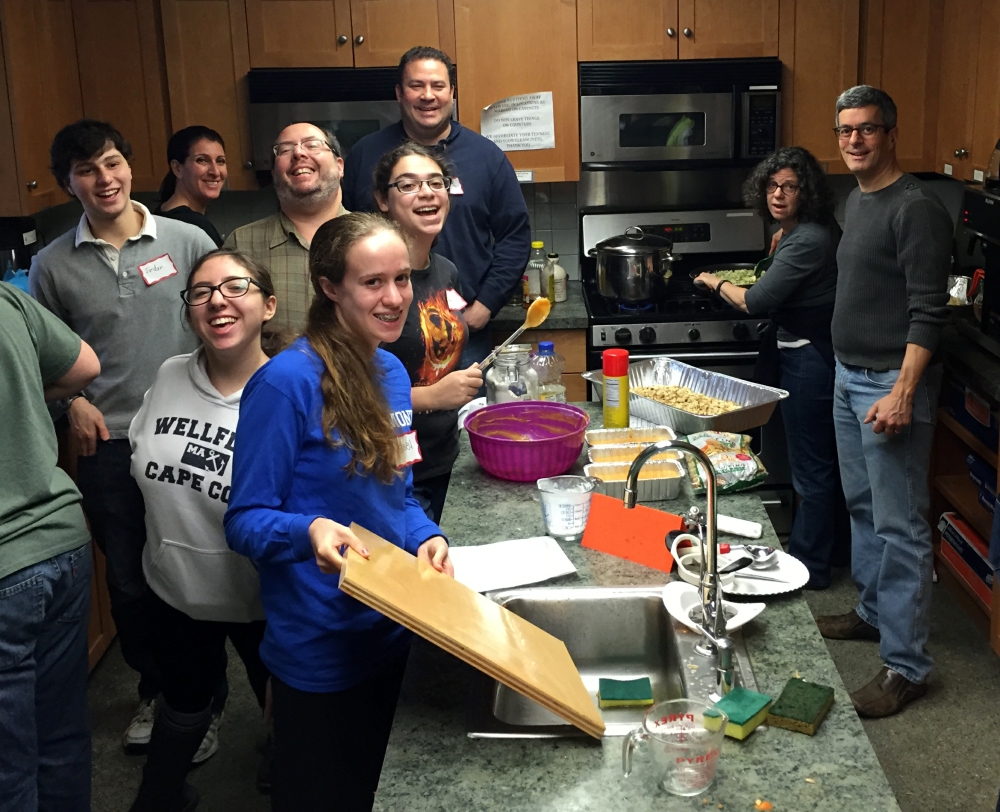
My 10th grade families prep Thanksgiving dinner for the homeless

The second Thanksgiving experience is meeting my Confirmation families in the vestibule just outside those sanctuary doors and spending Thanksgiving morning preparing a turkey dinner with all the requisite fixings that we then deliver to the VOA Shelter in Valhalla. In my opinion, there’s no better way to prepare for my Thanksgiving meal than by joining together with my temple family in assisting other families so that they can also celebrate Thanksgiving.

By the time I sit down to the third prong of my Thanksgiving experience – the Dreskin turkey dinner with the people I love most – my heart is already full and just waiting for my stomach to catch up. I go to sleep more spiritually satisfied on Thanksgiving than perhaps any other day of the year.

I share this with you because we’re living in an especially unsettling and disturbing time in history. And we should be disturbed. No one should celebrate this weekend without acknowledging the continuing injustices of American racism, American sexism, American homophobia, American economic inequality, and American diplomatic arrogance. Not to mention, the continuing American indifference to the Native American. Did you know that there has never been a public apology for our government’s murdering American Indians by the tens of thousands, stealing their land and booting the survivors onto reservations. This week marks the 150th anniversary of the Sand Creek Massacre, in which 200 women, children and older men were killed by Union troops during the Civil War for no militarily justifiable reason. What we did to the American Indian is unconscionable. That no one in this country has ever said “We’re sorry” defies both my comprehension and every fibre of my being that thinks about and tries to do what’s right.

jacobs-ladder

Jacob’s Ladder (Dennis C. De Mars)

In this week’s Torah parashah, Vayetzay, Jacob dreams his famous dream of a ladder that reached into heaven and which had angels moving up and down its rungs. Jacob’s understanding of the dream was that God was nearby, so Jacob offered to allow God to be his God if Jacob was able to safely return home from the journey upon which he had embarked. This wasn’t exactly Jacob’s most noble moment, although it was somewhat more impressive than his earlier demonstrations of selfishness and arrogance when he sold his starving brother a meal and stole that brother’s blessing from their dying dad.

Sometimes I’m so grateful that my ancestors were being persecuted and pummeled in Eastern Europe while the early American settlers were destroying this land’s indigenous peoples. But my being a descendant of Jacob the Deceiver doesn’t bode much better. The point here, I think, is that we humans bungle life a lot. We hurt and destroy, taking what we desire, with nary a pause to consider the dishonor of our actions.

The great irony of Thanksgiving is that it celebrates a moment in our American past that, even if such a meal really occurred, served as a prequel to a disaster of cruel and epic proportions. It’s just possible that Thanksgiving ought to be called Apologiesgiving, something akin to an American Yom Kippur.

But just as Jacob’s story doesn’t end with his shortcomings, but with a transformation that enables him to reconcile with, and finally offer love to, his brother Esau, and then to father Joseph who would shine as a leader not only of our people, but of the ancient Egyptian people as well … just as Jacob’s story turns to these finer values and better outcomes, so too can the American story, which in places already has.

Racism may not be gone, but America is a whole lot better place to be black than it used to be. Same with sexism and with homophobia too. There’s so much more work to be done, but we’ve made enough progress that we needn’t feel discouraged; we need merely to strengthen our resolve.

GivingThanks.02True thanks, of course, is not something that’s demonstrated by stuffing our gullets. There’s nothing at all wrong with a symbolic, ritual moment. Goodness knows, I’ve participated in more than a few of those myself. But what’s vital is that our symbolic acts become literal, hands-on endeavors to bring a fuller, more complete justice into our communities.

Ferguson, Missouri, is a moment teaching us that the work of the civil rights movement is not done, that beyond our legal system we still need to integrate values of tolerance and brotherhood into our daily lives. And I think we can do it. When I look at the transformation of this country vis-a-vis same-sex marriage, now legal in 35 states, I am so deeply hopeful. Things do get better. Life can and does improve, even if it sometimes takes a very long time. Always too much time. But we get there, don’t we?

And on this Thanksgiving weekend, that’s worth giving our heartfelt thanks.

When “That Moment” Arrives

bravery1Courage: the ability to do something that you know is difficult or dangerous. Hero: a person who is admired for courageous action.

The fire in a small warehouse had been burning for hours. The little community had no means of fighting it and other buildings were being threatened. Suddenly, down the hill roared an old truck. Right through the flames the truck sped, bringing to the epicenter of the blaze a crew of farm workers who had been riding in the truck’s rear. Jumping from the vehicle, the workers beat at the flames with their coats until the fire was completely extinguished. The grateful citizens thanked them profusely and immediately scheduled an evening to honor them. The town raised a thousand dollars and presented it to the driver of the truck. They asked him what he was going to do with the money and, without a moment’s hesitation, he replied, “Fix the brakes on my truck!”

Bravery is much admired across the world. Individuals who are willing to step up in a moment of crisis, to do what is important but what others fear, is an attribute I imagine we all aspire to possess. But for many, if not most of us, we’re probably more like that truck driver whose vehicle was simply out of control and had no choice but to plunge into the fire (or perhaps moreso, we’re like the unsuspecting passengers in the back of that truck, who could only go where the driver took them).

But there are some amazing people who have stepped up and done fantastically courageous deeds. Malala Yousafzai, who just won the Nobel Peace Prize for her relentless devotion to educating young women in Pakistan, and doing so in the face of thugs who would see her dead. Andre Trocme, and the citizens of Les Chambons, France, about whom we read earlier this evening, an entire town that rescued thousands of Jews during the Holocaust when so many others did nothing. Those who headed into the World Trade Center on September 11, 2001, while others were running out, and gave their lives to try and save the endangered. Jackie Robinson, who in 1947 bravely faced down narrow-minded bigots as he broke the color barrier in major league baseball.

What is it that makes an ordinary person into a hero?

At the beginning of the Book of Joshua, which comes right after the end of Deuteronomy and the Torah, Moses has died and Joshua has been appointed his successor. Way back in Exodus, Joshua had already proved himself a tremendous warrior and leader, guiding the Israelite troops to victory against Amalek, perhaps their most reviled enemy. And when Moses ascended Mount Sinai to receive the Torah, only Joshua accompanied him up that mountain, only Joshua was trusted by both Moses and God to stand on that holy ground. And yet, when he was appointed Moses’ successor, one could not help but wonder what went through his own mind: “Will I meet God’s expectations? Will I prove able to continue Moses’ work? Will I be able to lead this people? Will the people obey me? Will I succeed in bringing them to the Promised Land?” God may have sensed the new leader’s hesitation when, only six verses into Joshua’s story, says to him, “Hazak ve’ematz … be strong and courageous.”

Even people who seem to define courage and bravery may themselves wonder why we would think of them as such a person.

In this week’s parasha, Bereshit, we return to the Garden of Eden and once again witness Adam and Eve’s banishment from paradise. After they have eaten of the forbidden fruit, God comes looking for them. Adam and Eve are afraid and try to hide among the Garden’s trees. Here, the Torah teaches its very first lesson in bravery: own up to your actions, take responsibility for your mistakes. Once God gets them talking, Adam blames Eve and Eve blames the snake. God decides they have some growing up to do and orders them to leave the Garden and to make their way through the world.

The word “hero” may begin not with saving lives but with living life with integrity, with caring enough to just be honest.

Truth is, while there are amazing people who have done some extraordinarily brave things, one could argue that just showing up to life – to work, to school, to the dinner table – is courageous enough. Because we don’t live in the Garden of Eden, life is quite complicated, and courage is often required of us in ordinary moments of our day – to make a presentation to our boss, answer a teacher’s question in front of the class, enter a room where there’s no one we know, stand in line as captains choose their teams, and on and on. Ordinary stuff … that can scare us stiff.

About a year ago, a woman walking with her child in Central Park saw another child fall into a pond and struggle to keep afloat. Reaching out to him, her arms weren’t long enough and so she went in to get him. Having helped the boy out of the water, she discovered she couldn’t save herself and would have to be rescued by others. She’d never intended to be a hero and then, having volunteered to do so, just as quickly needed a hero herself.

I wonder. What is required for any of us to step into the fray and to do what we can when it’s more than we’ve done before? I think of the reading we’ve heard so many times during services in this room …

The question engaged me: Would I have been on Noah’s Ark, to see the rains cover the earth? Would I have been righteous in my generation, and lived to witness the golden tones of the rainbow? Would Abraham have taken me with him to survey the destruction of Sodom? Would I have been among the fifty righteous? Would I have been the pillar of salt? Would I have been righteous in my generation?

I know we humans can surprise ourselves. I know that some of the most unadmired, untrustworthy people in the world have stepped up when true crisis called for brave and selfless response. But, for the most part, I think that courage begins with a simple upbringing of goodness and honesty. Building up a couple of decades of consistent human decency probably sets the stage for one to be able, in a pinch, to do the extraordinary.

silhouette-family-with-eclipse-1On a sunny afternoon in Oklahoma City, a father had taken his two kids to play miniature golf. Walking up to the ticket counter, he asked, “How much for a game?” The young man sitting behind the counter answered, “Eight dollars for you and eight dollars for any kid over six. Six and under get in free.” The man said, “Well, the lawyer’s seven and the doctor is nine, so I guess I owe you twenty-four bucks.”

“Hey, mister,” the young man replied, “did you just win the lottery or something? You could have saved yourself eight bucks if you’d told me the younger one was six. I wouldn’t have known the difference.” The dad looked at his son and daughter and then said, “That may be true, but my kids would have known.”

Courage: the ability to do something that you know is difficult or dangerous. Hero: a person who is admired for courageous action. Where do such people come from? If I had to try and anticipate who might one day become a hero, I’d look to that dad and his two kids. It probably has to start somewhere, don’t you think?

Noah: Pathway to a Second Chance

I offered this sermon during Kol Nidre evening 5775 (Oct 3, 2014).

Billy


Fiddler on the Roof is coming back to Broadway this year. That’s good news because everybody should see it at least once. So get tickets for the little ones. There’s a classic scene in which Tevya is explaining how Jewish communities work. He says, “Of course, there was the time when he sold him a horse, but delivered a mule, but that’s all settled now. Now we live in simple peace and harmony and …”

“It was a horse,” interrupts one man. “It was a mule!” proclaims another. Horse! Mule! Horse! Mule!

“Tradition, tradition …”

Fiddler gets more credit for explaining Jewish culture than it probably deserves, but in this case, it gets it right. Judaism has never been monolithic. There’s hardly anything we all agree upon. And we know it!

Argumentation is embedded in Jewish culture. How else could we have a story where two individuals are discussing their synagogue’s minhag, their customary practices – in this case whether to stand up or sit down for the Shema – and one argues that we sit, while the other insists that we stand? So they sought out the oldest member of the synagogue, who explained that the arguing about whether we stand or sit, that is the tradition.

Which makes it surprising and somewhat perplexing that so many of us believe there is only one acceptable way to view the Torah … as God’s revealed word whose literal meaning we must obey … or not. In fact, even among those who believe that the Torah came directly from God, they’ve been arguing about what God meant for thousands of years.

There is, in Judaism, a body of literature called Midrash, a broad genre of Jewish intellectual creativity that began around the 2nd century BCE, perhaps 300 years after the Torah had been written down. Across the centuries, Jews have been questioning the Torah and engaging in some remarkably inventive thinking of their own that doesn’t rewrite the Torah but fills in blanks where parts of the stories seem to have been left out. American Jewish scholar Jacob Neusner teaches that our Jewish sages “did not write about scripture, they wrote with Scripture.” It didn’t bother them one iota that they were playing with sacred text. For them, it was a mitzvah to participate in the continuing creation of Torah. So long as they didn’t contradict what was already there, Torah text was fair game.

Midrash peers in between the words of Torah, and asks what elements of the story are hiding inside. Which brings me to a film that I imagine very few of you have seen: Noah, starring Jennifer Connelly, Emma Watson and Russell Crowe. When Noah came out this past March, you may have thought it belonged to the same category of Bible films as Mel Gibson’s Passion of the Christ. It didn’t, and it doesn’t. Noah disappointed a lot of people who resented how far its film makers had strayed from the original story line. But they hadn’t, because their intention was never to just retell the biblical version. They were creating midrash. The writers, Darren Aronofsky and Ari Handel, are two good Jewish boys. They’re not our “Mel Gibsons,” they weren’t interested in creating a “biblical epic.” They’d studied the Midrash on Noah, and they knew that Jews had a lot of lingering questions about the Flood story, answers which the ancient Midrash has played with, and a few of which they came up with on their own.

NoahI want to share with you some of the midrashim that Aronofsky and Handel used in their film. I want to do this, on Kol Nidre of all times, for two reasons. First, to demonstrate how Jewish thought only begins with the Torah, and that we limit our understanding of Judaism and, quite frankly, of life when we encounter nothing more of Jewish thought than Torah alone. Second, I want to show you the breadth and depth of Jewish learning, to encourage you to do some Jewish learning of your own, to not limit your Jewish knowledge to the stories you were told in childhood. Judaism is more fun than that, and it has so much more to say about life than is apparent in the Torah.

The story of Noah could be thought of as a simple one, like the one we share with our children, the one we represent by a big boat that has lots of smiling pairs of animals on it, a simple tale in which the wicked are removed from the earth and Creation is given a chance to start anew. But if we look closely at the language of Torah, at the words chosen to tell this story, and give ourselves permission to wonder why those words, why say it that way, we open up new possibilities for how we can understand Noah.

For example, in the very first verse of the Genesis Flood story, Noah is described as a man who was pure and righteous. And that would certainly help to explain how he got chosen to save the world. But the Torah adds an additional word, b’dorotav, which means “in his generation.” Why add that? If he was pure and righteous, isn’t that all that would matter? So we might wonder how b’dorotav changes the verse’s meaning. “Noah was pure and righteous in his generation.” Is that any different? A few questions come to mind? Like would Noah have been considered pure and righteous had he lived in another generation? Perhaps he was a thief, a murderer even, but compared to everybody else in his time – a time when God has decided human beings deserve to die – maybe Noah was still better than the rest. The best of a lot of bad choices. On the other hand, in such a corrupt world, perhaps it was even more difficult to be good than at another time. In a different era, Noah might have been a saint!

In the film, the writers play with this idea. There is no doubt that this Noah cares about the earth, cares about life, cares about his family, would care about others if there were any good people remaining. But this Noah you don’t push around. He’s not the jolly, bearded, Santa Claus-looking fella depicted in the dolls we give to our little ones. This Noah is a warrior. He knows how to wield a sword. And more than a little blood is shed by him in defense of his family and of the Ark. 20th century Torah commentator Nehama Leibowitz writes that while Abraham had been singled out for a mission, “Noah was singled out for survival.” This is not your mother’s idea of “pure and righteous”!

God then instructs Noah to build an Ark. In simple readings of the text, we merely assume he gets the job done, even though, by the Torah’s measurements, it would have been longer than a football field. He had his three sons helping him, but one wonders what technology would have allowed the four of them to complete a project that big, how long would that have taken, and what were Noah’s neighbors doing while this boat was being built next door?

Enter the movie’s construction crew: Semyaza and Ramiel. Giant, transformer-like stone creatures, Aronofsky and Handel did not make them up. The Midrash tells us that Semyaza and Ramiel were celestial beings that had been charged by God with looking after the newly-created human race. According to the Book of Enoch, a collection of stories attributed to Noah’s great-grandfather Enoch and written down maybe 250 years after the Torah, these creatures – known as the Watchers, angels who consorted with humans and fathered the Nephilim who appear in Genesis just prior to the Flood story – the Watchers fell from grace and, as punishment for their behavior, God had them bound for seventy generations. In Noah, the Watchers appear as celestial light encrusted in prisons of stone. They ally with Noah against the evil hordes and assist him in building the Ark.

Now, if you were building an Ark, do you suppose you could keep it a secret for very long? Midrash tells us the Ark’s construction took 120 years, time to grow the lumber, harvest it, and then build the boat. In that time, we are told in a number of Jewish sources across the ages, that people would ask Team Noah what they were doing. When Noah would answer that they were making an Ark to save Creation from the immanent Flood, people would mock him, use vile language, and cause Noah to suffer violently at their hands. So when the movie assigns these giant Watchers to protect Noah, the writers weren’t the first to worry for Noah’s safety.

Then the rain begins. Gentle at first, but probably a wake-up call to the locals who might realize they could have spent the last 120 years building their own boats. They soon organize and attack Noah’s. The Midrash imagines that the lions and other wild animals emerged from the Ark to defend it. In the film, the Watchers protect the Ark. They are all killed while doing so and their celestial lights, formerly trapped in stone prisons, are redeemed by their service to God and to Creation, and rise to heaven where they are welcomed home.

This night of Kol Nidre returns each year to remind us that ours is a heritage in which no one is beyond redemption. Each of us retains the possibility of teshuvah, of returning to goodness and to our essential humanity. The Watchers’ release from their prisons of stone is very much in line with what our heritage has taught throughout the ages. Sci-fi? Definitely! Jewish? That too.

Back to the movie. It’s dark inside the Ark – windows aren’t such a good idea when flood waters are rising. The Genesis text tells us that God instructed Noah to build a tzohar in the Ark. Some translators assume that’s a skylight so that there’s some illumination. But a skylight during a deluge doesn’t seem like such a good idea to me. How ‘bout you? And besides, really bad storms make it pretty dark out anyway. The word tzohar is a hapax legomenon, a word that appears only one time in the entire Tanakh. So not only are we completely unsure as to what the word means, it’s a moment that’s ripe for midrash. Rashi, the most famous and highly-respected commentator of them all (he lived in 11th century France), wrote that some believe the tzohar was a window while others believe it was a wondrous, luminescent stone. Part of the reason for their fanciful thinking here is their agreement that a window would have been a pretty stupid idea. And part of it is that tzohar is similar to tzohorayim, the Hebrew word for afternoon, which may mean the word is less about an object and more about a form of light. In a bunch of midrashic collections, the rabbis imagine tzohar to be a magical stone that contains the very light of Creation, and that’s what the film makers gave to their Noah to brighten his dreary surroundings.

One of the reasons people are unhappy with this film is when Noah decides that God had him build the Ark in order to save the animals but not the humans. Noah believes that he and his family are to tend the Ark’s passengers and will live out their own lives after the Flood but are not themselves to reproduce. The story of human beings is to end with them.

But the message of the Flood story in Genesis seems to be one of second chances. And humankind is included. However, you and I have the benefit of knowing the story. Noah would not have had that advantage. The question is, did the writers violate the simple meaning of the biblical story by building their Noah as an end-of-times fatalist? Let’s take a look.

In the Torah, Noah is told that God is going “to put an end to all flesh.” Hineni mash-khee-tahm et ha’aretz … I will destroy them with the earth. God instructs Noah to take his family into the Ark, but never explicitly says they are to repopulate the earth. This close reading opens up the possibility that Noah thought his job was to build and to captain the Ark, but that he and his family would not survive the trip. The film’s writers asked a great question about Noah’s state of mind. And remember, as long as it doesn’t contradict what’s already written in the Torah, midrash frees us to imagine most anything we want in between the words. By the end of the story, Noah understands that humanity is also to be saved. But at this early point? Well, what would you have thought?

Once the Ark set sail, the animals had to be tended to. The film departs from Midrash here, but both respond to the question, “How could one family have possibly taken care of so many animals for all that time?” Time, by the way, was not forty days and forty nights, but a full year. And that’s actually clear in the biblical text. The rain fell for forty days and nights, but the floodwaters would take many more months to recede and it would be a full year before the Ark’s door would reopen and life on earth could begin again.

While on the Ark, the Midrash tells us that Noah and his family got no sleep because of all the time it took to care for the ship’s passengers. The film depicts Noah’s family, prior to departure, walking the decks waving some sort of herbal smoke machine, and putting the animals to sleep for the duration of the journey. Ancient midrash meets modern midrash. Considering what we know about bears hibernating in the wintertime, the film’s choice may be more believable than what the rabbis imagined. In either case, the question, “How did all those animals get fed?” gets asked by Torah readers because the Torah itself doesn’t say.

One more bit of Midrash for you. The Noah story doesn’t just end with a rainbow and a promise. It has a difficult ending to it, I think because life, even when we get happy endings, can change irrevocably and our happiness is sometimes tempered by the pain, loss, or defeat that someone must experience in order for us to succeed. Why do you suppose that even after the Ark had survived its journey, the animals had emerged and gone out to repopulate nature, and Noah’s family had also begun life anew, why does Noah plant grapes and drink himself into a stupor? Mind you, this wasn’t a one-day boozing; we’re talking a season of planting, harvesting, crushing and fermenting, followed by a formidable period of getting lacquered and hosed. Why?

Two possibilities. First, the movie suggests that Noah believes he failed in his mission. He thought he was to end the human race but was unable to do so. The second possibility appears in the Zohar, Judaism’s preeminent mystical text, which suggests that, upon emerging from the Ark, Noah looked around, saw the devastation which the Flood had caused, and confronted God, demanding to know why mercy could not have ruled the day and saved Creation. God responds with an anthropomorphic slap across the jaw, countering with, “Now you ask me such a question! Perhaps before the Flood, had you confronted Me then, it might have effected a rescue. But you took care only of your family. Too little, too late!” Noah was devastated. That could be why his own ship was three sheets to the wind.

Let me add a personal note. Five years ago, I journeyed on an ark of my own. When I disembarked, my eldest son was gone. Each day since 2009, I have struggled to live my life without my son Jonah in it – my world minus one. As difficult as that has been, I try to imagine what it must have been like for Noah. What of his brothers and sisters? His parents and grandparents? His friends? The millions who would receive no second chance? No wonder he tied one on. How do you live in the aftermath of that kind of indiscriminate, universal destruction?

Our ancestors’ questions for God were never just about the characters in the Torah. They were always trying to better understand what it means for us to be human and how we could best live our lives despite our own shortcomings and the difficulties each of us faces in merely striving to feed and shelter ourselves and those we love. Their questions from a thousand years ago, two thousand years, even three thousand years ago, are our questions too. They may not have known about electricity, plumbing or amazon.com, but they knew about fear and illness and love and peace. Their stories may not have actually happened, but they are as true today as any story you or I will live.

All of these midrashim on Noah’s story demonstrate that Jewish knowledge has never been limited to the text of the Torah. Those Five Books, sacred as they are, merely comprise the starting point for the wealth of experience and wisdom our heritage has waiting for us. Each time we open one of those ancient books, within its pages we will find a mirror reflecting our own concerns, our own questions, our own dreams and hopes, right back at us.

That’s why Jews study. That’s why I believe you will love joining our community of learners here at Woodlands. Whether you study Talmud or Israel with me, a Taste of Judaism or Prayer with Rabbi Mara, the Midrash of Creation with Rav Julius Rabinowitz, or any other adult learning opportunity here at temple, the goal is not to acquire facts but to grow in spirit, not to become encyclopedic but empathetic. My teacher Rabbi Larry Hoffman used to say that we study Jewish texts not just to meet our ancestors but to meet ourselves. It is such a valuable and worthwhile use of time.

Oh, and see the film. It’s a great lesson in Midrash, in the complexity of the human experience which our ancestors have reflected and written about in every year since the Torah got written down.

Avinu Malkeynu … it is Kol Nidre. The time to release ourselves from vows with You that we have not kept. But why shouldn’t we make a few new ones? It’s a New Year, after all. An excellent time to think about how we can strengthen and straighten our highest, noblest values. Learning a bit with You, God, even arguing with You, could be a great new direction in the year ahead. Ken y’hee ratzon … may these words be worthy of coming true.


Closing words at the end of the service
The Torah tells us that Noah entered the Ark “with his sons, his wife, and his sons’ wives.” As is typical for ancient texts, we know little of these women, which means that Midrash is waiting to happen. In this case, midrash from Darren Aronofsky and Ari Handel. Noah’s stepdaughter, Ila, played by Emma Watson, speaks with a Noah who is drunk and in despair at what has become of the planet. The film makers have Ila teaching Noah that God has given us a world in which we are supposed to make choices. There will always be ambiguity and doubt. Nevertheless, we are in possession of mercy and love to assist us in making our choices. With the Ark, God gave humanity a second chance, a chance to live a good life on God’s earth. It is when Noah embraces this second chance and returns to life and to building goodness … that the sun comes out and the rainbow appears.

Avinu Malkeynu … Yours is a world that frequently offers us second chances. On this night of Kol Nidre, of release from vows, may we make a new vow. May we accept Your great gift of teshuvah, of turning, of redemption, of a second chance. And may we ask ourselves, “What will we do with that second chance? What are we doing with that second chance? Are we making certain that we use it for inscribing all of life into the Book of Life?

Science versus Religion?

I offered this sermon during Rosh Hashanah morning 5775 (Sep 25, 2014).

Billy


During the French Revolution’s Reign of Terror, three men were to be executed by guillotine: a rabbi, a priest, and a rationalist skeptic.

The rabbi was the first to be marched up onto the platform. There, facing Madame Guillotine, he was asked if he had any last words. The rabbi recited the Shema and pleaded with God to save him. The executioner positioned the rabbi beneath the blade, placed the block above his neck, and pulled the lever that set the terrible instrument in motion. The heavy cleaver plunged downward, searing the air. But with a crack, just a few inches above the rabbi’s neck, the blade suddenly stopped. “It’s a miracle!” gasped the crowd, and the executioner had to agree. The rabbi was released.

Next in line was the priest. Asked if he had any last words, the priest cried out, “Our Father, who art in heaven, rescue me in my hour of need.” The executioner positioned the priest beneath the blade and pulled the lever. Again the blade flew downward, stopping one inch, and no more, short of its mark. “Another miracle.” the crowd called out, this time with discernible disappointment. And for a second time, the executioner released his victim.

Now it was the skeptic’s turn. “Any last words?” he was asked. But the skeptic wasn’t paying attention. He was staring intently at Madame G, and not until the executioner poked him in the ribs and the question was asked again did he reply, “Oh, I see your problem. You’ve got a blockage in the gear assembly right … there!”

Which may explain why there are fewer rationalist skeptics than true believers in the world today.

This is the beginning of my twentieth year at Woodlands. First, thanks for the job. I love this temple. Second, in all these years, I still feel like people who question, or who outright don’t believe in, God still shrink from letting me know. Folks, this is a Reform synagogue. You’ve had rabbis who don’t believe in God. I happen to be an agnostic. I try to be humble enough to never assert that I am somehow in possession of any real knowledge of the universe’s Creator.

Let me share with you a passage from “The Pittsburgh Platform,” a statement of guiding principles for Jewish life that was put together by America’s Reform rabbis back in 1885: “We recognize in every religion an attempt to grasp the Infinite, and in every mode, source or book of revelation held sacred in any religious system the consciousness of the indwelling of God in man. We hold that Judaism presents the highest conception of the God-idea as taught in our Holy Scriptures and developed and spiritualized by the Jewish teachers, in accordance with the moral and philosophical progress of their respective ages. We maintain that Judaism preserved and defended amidst continual struggles and trials and under enforced isolation this God-idea as the central religious truth for the human race.”

“God-idea.” I like these guys. They were well-educated and honest spiritual leaders who understood how little they understood about God. The term “God-idea” allowed them to articulate their desire and hope that there is a God, but also their refusal to assert that they indisputably knew anything about God.

Science&ReligionThere may or may not be a God in the universe. This cannot, and quite likely will not, ever be proved. That’s what faith is. You and I get to choose: believe in God, don’t believe in God. I say don’t even bother trying to substantiate your position. It’s a leap of faith. You may employ logic, even science, to stake out your position, including that of the atheist. But in the end, we’re just choosing the one we want.

That’s the simplest explanation I can offer you as to why science and religion are completely compatible. Neither can prove or disprove God. Theology can’t prove it, even if we use a lot of clever logic. And science can’t disprove it because God, by definition, is beyond the natural world. God would have been the Creator of the laws of physics; not bound by them. When creation started off with a Big Bang some fifteen billion years ago, that beginning was preceded by, astoundingly enough, nothing. No light, no space, no mass. And science doesn’t know what to do with that. Except to wonder and to be amazed. And that’s what religion is all about: wonder and amazement.

Did God create the universe? Who can say? Science starts its explanation of Creation after Creation’s already happened! There’s a number, Planck’s Constant it’s called, that identifies a moment which occurred one teeny-tiny fraction of a second after the Big Bang. That, according to the scientific community, is when the laws of quantum physics kicked in and anything intelligent can be said about creation. Everything before that is poetry and faith.

Tomorrow morning’s Torah reading will be the story of Creation. Now, that story was written down some 2500 years ago. Among the more recent conversations that are typically kept from me and Rabbi Mara is the one that goes like this: “The story of Creation as told in the book of Genesis is not true. It can’t be true. Science tells us the real story. Science teaches us the way Creation really went down.”

I’m okay with most of that reasoning. Again, I don’t know why you won’t talk to your clergy about this. We’re as steeped in science as you are. But there are some people here who will speak with me. Come join me in the Meeting Room some Wednesday evening or Sunday morning when I’m studying Torah with the seventh grade. Seventh graders are fearless. They say what’s on their mind. Somehow they haven’t yet learned to filter their honest thinking when in the presence of a rabbi.

These seventh graders, studying the Genesis account of Creation, are quick to notice a couple of things about the ancient storytellers. First, Creation doesn’t begin “in the beginning.” That’s a mistranslation you and I have been living with for far too long. Bereshit bara Elohim does not mean “In the beginning, God created the heavens and the earth.” The correct translation is, “When God began creating the heavens and the earth.” And what does that say to my fearless seventh graders? It says that the authors of the Torah didn’t presume to know what there was “in the beginning.” Could have been something, could have been nothing. So they started in the middle, or perhaps a teeny-tiny fraction of a second after the beginning, just like every scientist does.

My seventh graders also noticed that the progression of created flora and fauna, which, in a Torah that was written down a very long time before Darwin did his work on the origin of the species, is remarkably similar to what Darwin would assert in the mid-1800s. These people were not scientists, but they weren’t dummies either. They intuited, without the evidence that would come later, that life on earth started simply and became more and more complex. Day one: a swirling mass of primordial matter. Day two: land and water aggregate. Day three: vegetation. Day four: sun, moon and stars (okay, I’ve got no idea why they placed these on the fourth day … ask my seventh graders). Day five: amphibious creatures and birds. Day six: land animals, large animals and, lastly, humankind. Remarkably similar to evolution, don’t you think?

What’s this mean for you and me? First, it may allow us to be more accepting of the Genesis account. As my seventh graders love to offer, “Maybe each of the six days of Creation was a lot longer than twenty-four hours.” Thirteenth-century commentator Nachmanides, the Ramban, might agree. He seems to have thought that since the sun, moon and stars weren’t created until the fourth day, there was no way that the first three could be described as happening in only twenty-four hours. The Ramban, it would appear, intuited the complexity of creating an entire universe, even if you’re God. Second, our ancestors were thoughtful about the origins of life. And Darwin, I think, would have been proud to have them as his students.

Even in the Talmud, written nearly two thousand years ago, our sages and rabbis readily admit they are not scientists, and that when new knowledge is discovered, they most willingly incorporated it not only into their world-view, but into their religious-view. For the Jewish sages, science and religion needed to be able to coexist.

This summer, the Union for Reform Judaism opened a new camp: 6 Points Science and Technology Academy. When I first learned about Sci-Tech at the 2013 URJ Biennial, I flipped. Not just because Paul Zaloom was onstage working his magic – or his science, rather – as he had done from 1992-1997 as the crazed but brilliant scientist Beakman in Beakman’s World. But also because the Sci-Tech Academy, he told us, would be a place where “scientific inquiry meets fun!” Campers would “explore what Judaism means to them—and how this complements their interests in science and technology.”

I knew I had to be there for this camp’s inaugural summer. Sci-Tech director Greg Kellner graciously accommodated my request, and this past June I found myself moving in for a week to The Governor’s Academy in Byfield, Massachusetts, Sci-Tech’s summer home. Through robotics, video game design, environmental science, and digital media, boys and girls in grades 5-10, including Woodlands’ science maniacs Jonathan Montague and Matthew Kaminskas, would not only explore these emergent technologies but they would be asked to consider how 21st century living – with its smartphones, the internet, GPS, wikipedia, text messaging, Netflix, cameras in our phones, and amazon.com – all impact on how we live, on the soul and the spirit of how we live. In other words, where does religious life – for us, Jewish life – intersect with science and technology? And how might one inform the other?

Rabbi Geoff Mitelman, Founding Director of Sinai and Synapses, an organization that seeks to bridge the scientific and religious worlds (and who I remember as a baseball-loving little boy who grew up here at Woodlands), writes of the ways in which people perceive how science and religion coexist (or not) in our world. His preference is that science and religion each inform the other so that both will not only thrive, but will do so with clarity, honesty and with integrity. If you’re thinking that only religion is in need of “clarity, honesty and integrity,” just remember who funds most of the scientific inquiry in our world: governments and the military. So spending some time reflecting on the ethics of science, the spirituality of science, could be very much worth the world’s while.

I’ll give you a few examples. DNA analysis. We not only possess the technology to identify the DNA profile of any human being, it’s rapidly becoming cheap enough and available enough that anybody can acquire such information. But what happens when you find out you carry a gene that might lead to breast cancer? Do you proactively remove a breast? What happens if you find out you carry a gene that might lead to abnormal pregnancy? Do you not get pregnant? And what about privacy issues? Insurance companies that obtain your DNA profile and deem you a poor risk? How about a potential employer doing the same?

Another example why pondering the soul of science may be worthwhile is driverless cars. To what standard do we hold a driverless car? The same as a new, teen-aged driver? Or something more rigorous? If driverless cars are programmed to obey the law, what about a situation where breaking the law would save someone’s life? And what if a situation calls not for saving a life but for ending one? What if five people are in danger of being hit by a driverless car, the car is able to sense the danger but determines that the only solution, the only way to save those five lives, is to veer off in a direction that would cause it to hit someone else, to deliberately end one life in order to save five? Is that ethical? Do we program the car to opt for intentional death in order to avoid unintentional death? And we’d best figure this out soon, because Zipcar is planning on using them as soon as they’re legal.

Religion is about ethics. Call it “obeying God,” if you will, but whether you live within a fundamentalist religious community where God’s commands are never questioned, or a liberal-progressive one where God’s role is always under discussion, religions seek to understand how you and I ought to behave in our day-to-day lives. In Judaism, the mitzvot regulate our daily behavior. Call it “doing God’s will,” but what it really is, is answering the question, “Why am I alive, and how ought I behave while I’m here?” Ethics are guidelines or rules for human behavior. Religion may gussy it up a bit, but it’s pretty much the same thing. While I would never give religion a veto, I do think it can sit at the table of scientific inquiry, serving as a voice of conscience, goading us toward moral clarity.

20th century Jewish philosopher Martin Buber wrote, “We shall accomplish nothing at all if we divide our world and our life into two domains: one in which God’s command is paramount, the other governed by the laws of economics, politics, and the ‘simple self-assertion’ of the group. […] Stopping one’s ears so as not to hear the voice from above is breaking the connection between existence and the meaning of existence.”

What Buber’s words are saying to me is that our world needs an integration of the rational and the spiritual. One ought not censor the other, but the two should be in conversation, even in argument. Judaism is better for science having taught it something about the origins of life. And science is better for all the world’s religions applying pressure to be considering not just the material benefits, but the moral consequences, of knowledge gained and applied.

My time at the Sci-Tech Academy did not change the way I see the universe. It underscored and implemented what I’ve always felt to be valuable and really important to our lives: that ideas of the spirit and of the physical world talk to each other. The world is such a complicated place. We need all the help we can get to make some reasonable, value-laden sense of it all.

Avinu Malkeynu … when the founders of our nation decreed that “Congress shall make no law respecting an establishment of religion,” I’m pretty sure they didn’t mean that You should be cordoned off from the laboratories and research institutes. My great tenet of faith is that science and religion should spend lots of time talking to each other. So long as we don’t lose our heads about it (to bring back the imagery of Madame Guillotine), I believe our lives and Your universe will be better for our having imbued the act of human creativity with the same sense of tov, of the goodness, with which our Torah imagines that You imbued the entire universe.

Ken y’hee ratzon … may these words be worthy of coming true.


Closing words at the end of the service
At the URJ Science and Technology Academy this summer, each morning began before breakfast with the Boker Big Bang. The camp gathered at an outdoor location, seated themselves close but not too close, because a daily experiment involving something that would either smoke, make dazzling arrays of color, or blow up, was about to take place.

Everyone from youngest to … rabbis … was excited about this moment. But we quickly learned that science is filled with many more failures than successes. And it soon became evident that the camp would need to embrace its duds as well as its kapows.

Rabbi Nathaniel Share, who led the New Orleans Reform Congregation Gates of Prayer from 1934-1974, taught the following: “Jewish tradition encourages us to strive to be failures. It does this by urging us to set standards of conduct for ourselves far higher than we can possibly attain. We will fall short. But what a glorious way to fail. For in failing to be as good as we might, we become better than we were.”

This is the spirit of our High Holy Days – set the bar as high as we possibly can, keep it in view for the entire year ahead. And when we fall short, applaud our efforts, the heights that we’ve achieved, and then return here, to this tent, next fall, and begin the whole, honorable process all over again.

Lighting Up the World

LighthouseIn this past weekend’s New York Times Sunday Review, an article appeared on the subject of lighthouses. James Taylor used to sing about lighthouses: “I’m a lonely lighthouse, not a ship out in the night, watching the sea. She’s come halfway ’round the world to see the light and to stay away from me.”

But like rotary telephones, typewriters, and S&H Green Stamps, lighthouses are mostly no longer needed. I hadn’t actually realized that technology had overtaken them too. Apparently, GPS works so well on land and sea that boats no longer require visual cues to keep them away from dangers that lurk in the watery depths.

So, like trying to figure out what to do with the first Tappan Zee Bridge once the second gets built, communities must determine whether or not it’s economically feasible to keep decommissioned lighthouses standing. It can take millions of dollars to keep a lighthouse in working order. So unless there’s a way to monetize that, it’s unlikely such maintenance will survive budget-time scrutiny.

Some lighthouses have been turned into out-of-the-way bed and breakfast inns. Others have simply been preserved as museums. The rest are being torn down.

I’ll come back to lighthouses in a moment.

MtSinaiA couple of thousand years ago, our ancestors stood together at a mountain called Sinai and received a document, along with a charge for how to live, that would direct their lives for the next hundred generations. In this evening’s Torah reading, Nitzavim, we will hear about that moment, and about who it included, which may surprise a few of you. In the book of Deuteronomy, chapter 29, we are told that every Israelite stood at the foot of Mount Sinai when Moses carried down God’s Torah. What’s wonderful about this passage is that the moment was not one of privilege or status. While yes, Israel’s leaders are there – they kind of have to be if this people is going to have any chance of following the new book of rules – so is every other Israelite. Spouses, kids, out-of-town guests, and even those at the lowest rungs of antiquity’s social ladder: woodchoppers and water-drawers.

The light from a lighthouse acknowledges no social standing, no financial position, no political connection, no prejudicial bias. That light is for everyone, to help one and all steer clear of danger.

Nitzavim, this week’s Torah reading, is a lighthouse. It offers its gifts to anyone who wishes to partake. I think it’s the perfect text to begin our new year.

Woodlands Community Temple is a pretty special place. I don’t know that it’s dramatically different from many other special places – other synagogues, churches, mosques, bowling alleys, American Legion halls, community centers, or any other room that houses a group of people who are trying to do something to elevate the value and meaning of their lives (a tall order, to be sure, but not at all unachieveable) – but the social experiment of building community to make life better for one’s self, one’s family and one’s world, is not only noble, it’s needed. It’s not a particularly difficult task to care for one another, but we do manage to trip over our own feet quite a bit of the time.

Nevertheless, good things have come out of the lighthouses we call synagogues. We teach our children values by which we hope they will live. We remind ourselves of those same values and encourage one another to strengthen our resolve to live by them. And we shine our light on people and places outside of our synagogue – not to convert, but to embrace. Through social action – tikkun olam, g’milut hasadim – we lend a helping hand to others because this ancient document has been challenging us to do so.

This may be why we read this particular passage from Nitzavim a number of times each year. Our Confirmands will read these verses next spring during their Shavuot service of Confirmation. Why? Because we hope they will internalize the Torah’s message of common vision and action. We will read it on Yom Kippur morning, just two weeks from now. Why? Because its “lighthouse” concept of helping one another to ennoble our lives is the challenge of the High Holy Days. To be written for a blessing in the Book of Life is not something we seek only for ourselves, but for every inhabitant of this planet. That is the Jewish dream, one we renew each year in that tent.

Two brief stories.

One comes from an animated short entitled “Lighthouse.” It concerns a lighthouse whose light unexpectedly goes out. With a ship fast approaching, the keeper of the lighthouse, not knowing what else to do, runs downstairs with the goal of heading into town and appealing for help from his fellow villagers. But when he opens his front door, he finds them already arrived and, lanterns in hand, the entire village ascends the steps of the lighthouse to warn off the approaching ship.

A sweet, powerful little story that reminds us of the importance of being part of a community and of stepping forward when the need is great.

Woodlands Community TempleThe other story concerns the building of a synagogue. A long time ago, plans were drawn up for the design of the community’s new synagogue. At its dedication, everyone came and marveled at the building’s breathtaking beauty. It wasn’t long, however, before someone notice the building had no light. “Where are the lamps?” someone asked. “How will our new synagogue be lit?” The rabbi indicated a number of brackets that had been mounted on the walls at regular intervals throughout the building. He then presented each family with a lamp that they were to carry with them whenever they came to the synagogue. “When you are not here,” the rabbi said, “part of this synagogue will not be lit. When you remain at home, especially when our community needs you, some part of God’s house will be dark.”

I love this story! And while I doubt that our Board of Trustees would go for implementing it as policy, the metaphor has indeed been implemented. As with any community gathering, Woodlands is strengthened by the participation of many, by your participation. When we come, you and I are strengthened. When we come, our families are strengthened. When we step forward to join our community – in whatever activity it inaugurates – our lives are affected. And like those old lighthouses, when we do step forward and we shine our light, our wider community, maybe even the whole world, is affected as well.

Billy

The B’nai Mitzvah Legacy of 9/11

I imagine that for most of us, there is no story we have heard as many times as that of the Israelites’ exodus from Egypt, their forty years of desert wandering, and subsequent entrance into the Promised Land. Each spring, we devote an entire evening around our dinner tables to retelling this story. And yet, we mostly do so in broad strokes. Rarely do we stop to consider what the Israelites ate throughout those four decades, what it was like to give birth and to rear children as homeless nomads, and (as mentioned in this evening’s Torah reading, Deut. 29:4) where they went shopping for new clothes:

“I led you through the wilderness forty years; the clothes on your back did not wear out, nor did the sandals on your feet.”

charlton-heston-as-moses-in-the-ten-commandmentsAs far as this last question, the Torah tells us they didn’t. For the duration of their trip – all forty years of it – neither their clothes nor their shoes ever wore out. They must have had dramatically different manufacturing standards back then because I sure can’t get a shirt to stay free of pilling to save my life.

I doubt, of course, that we were meant to take this literally. That the Israelites were able to make the journey at all, that they managed to get out of Egypt, that they survived as a community during that period post-enslavement and pre-Holy Land, is even more miraculous than a well-preserved pair of chinos.

But it got me thinking about time, and about what changes, what wears down, or doesn’t wear down.

Forty years is a very human chunk of time. For a kid, it’s forever. For a forty-year old, it’s a recognition that time has passed but life is chock-full of promise and achievement. For a sixty-year old, it’s a mixed blessing. I’m fifty-seven. I find myself thinking about “forty years ago” quite a bit. I think about what my body could do forty years ago. I think about where my life’s adventures were unfolding forty years ago. And I think about where, forty years ago, I thought I’d be today. And where I thought the world would be today.

Truth is, we do wear out. Used to be my doctor hardly knew me. Now we finish each other’s jokes.

The other truth is, the world wears out too. Forty years ago, 1974, some of the big music hits included “Billy, Don’t Be a Hero,” Paul Anka’s “Having My Baby,” Paper Lace’s “The Night Chicago Died,” and Maria Muldaur’s “Midnight at the Oasis.” Chinatown, Young Frankenstein and Blazing Saddles were playing on the silver screen. And in the news, India had gotten the bomb, Patty Hearst was kidnapped, first-class postage went up to a dime, Ed Sullivan died, and Richard Nixon resigned.

More importantly, we’re still fighting wars, still struggling with racism and, more than most of us could ever have imagined, we’re confronting more and worse terrorism than the world has ever known.

911.5thAnniversaryThirteen years ago, hijacked commercial airliners brought down the World Trade Center and damaged the Pentagon. Some 3000 human beings perished In New York, Washington and Shanksville, Pennsylvania, on that day. And more in the years following, from illnesses contracted through contact with toxic materials, affecting not only survivors but responders as well.

America was, of course, deeply affected by the events of that day. Our economy was thrashed. Our airport security underwent a sea-change. And our insecurity about Muslims among us rose precipitously. Whether this is a momentary period of difficulty and challenge, or our world has been changed forever, who can tell? For right now, at least, terrorism seems far more possible to upend our lives than war.

Just about the only good that came out of 9/11 was America’s increased sympathy, now empathy, for Israel. Despite grumblings about Israel’s possible lack of proportional response this past summer, Americans now understand what it’s like to live under the spectre of having enemies who want you dead and are happy to rain down destruction not on soldiers but on civilians whenever they are able.

Thirteen years is an interesting length of Jewish time. Thirteen, of course, is when our children reach their traditional majority, when they are old enough to step up and fully integrate into their communities and to become full-fledged partners in building Jewish life. 9/11 is thirteen years old. I wonder if it has been fully integrated into our national consciousness, or what that integration would even mean. I think of Gettysburg and how the horror of that grisly battle has receded far into the memory banks of the American people. What we remember about Gettysburg is Abraham Lincoln’s stirring speech. What about Vietnam? Have we integrated that into our American lives? We make movies about it now; is that the indicator?

We think of thirteen-year olds as reaching a certain level of maturity. And we all know some who have and others who have not. Thirteen is kind of an arbitrary number but, for each of our kids, we celebrate then as if to say to them, “Wherever you are in your journey, we applaud what you have achieved thus far and we look forward to your continued growth.” For the American people, I imagine it’s a similar kind of idea. Some Americans still believe there are no decent Muslims in the world. Others of us remain open to building bridges wherever we can.

Our parashah this evening, Kee Tavo, recalls our most famous story, those forty years in which we matured from slave-children into free men and women. Our outer garments may not have changed, but our hearts and our minds most certainly did. On this 13th anniversary of 9/11, may we continue to learn both strength and compassion, so that we may protect all whom we love and, someday we pray, come to love even those from whom we must protect.

The rabbis-of-old taught that, 2000 years ago, when the Jerusalem Temple was destroyed and people wanted to know where God had been during destruction, and people wanted to know where God was now in their despair and grief, the rabbis told them God was with them — crying with them, mourning with them, and seeking comfort among them.

As we ponder our ancestors’ 40-year journey in the desert, a journey we are told was accompanied by God’s continuous presence, may we never despair. Even when life seems overwhelmed by difficulty, may we ever link arms with one another to insure that goodness never dies, may we be forever confident that God has not abandoned us and that, indeed, it is when we reach for one another that we find God. And in so doing, may we discover, like our desert forebears, that when life’s harshness includes persistent determination and love, not our outer garments nor our inner ones will ever wear out.

Billy

Israel and the Palestinians: Piecing Together Peace

PromisedLandIn this week’s Torah parasha, Mass’ei, the Israelites are finishing up their forty years of desert wandering and are preparing to enter the Promised Land. “The Promised Land.” Promised by God, our tradition tells us. And further, we were not to share it with anybody else. Listen: “On the steppes of Moav, at the Jordan near Jericho, God spoke to Moses, saying: ‘Tell the Israelite people … When you cross the Jordan into the land of Canaan, you shall dispossess all the inhabitants of the land. […] You shall take possession of the land and settle in it, for I have assigned the land to you to possess.’”

That was Numbers 33:50-53. This week’s Torah reading. We’ve been teaching this idea to one another for 2500 years! We taught it while we lived in ancient Israel. We taught it while we were in Exile, wandering across Europe, living in ghettos and enduring pogroms. And we still teach it, as a second commonwealth of Israel is now being built on that ancient land. The Torah is quite clear. Israel belongs to the Jewish people.

Islam’s Qur’an seems to be a bit less precise. In some passages, the Qur’an explicitly acknowledges that God gave the Land of Israel to the Jewish people. Forever. But in other sections, the Holy Land has been turned over by God to the Muslim people who have been deemed more worthy than the Jews.1

The end result appears to be the same: Two peoples vying for the same parcel of land. Each one citing its ancient scripture as the prooftext for its claim.

And yet, no one is going anywhere. The Arabs have not succeeded in pushing the Jews into the sea. Nor have the Israelis succeeded in making the Palestinians go away. In my opinion, the sooner these neighbors realize that neither one is disappearing, that they’re either going to have to learn to live together or destroy each other, the sooner peace can become a real possibility.

You and I, watching the latest outbreak of violence from afar, shake our heads in disbelief and despair at how long this has been going on. Why, we ask, don’t they finally insist upon peace? Why is it that each time fighting breaks out, they kill each other until a cease-fire is declared, and then return to their corners, preparing for the inevitable renewal of violence somewhere down the road.

CoexistBut hold on, there are Israelis and Palestinians who believe in a path other than one littered with violence. Some are literally agitating for peace (more on that later), while others are building it through cooperative ventures on behalf of both peoples.

First there’s The Villages Group, Israelis and Palestinians who live near one another and who maintain daily contact via economic activity, sharing resources, and basic human relationships. The premise is a simple one: we either learn to live together, or we’ll die.

One of my favorite cooperative ventures was shared this week with me by young Maya over here. It’s a Facebook page entitled “Jews and Arabs Refuse to Be Enemies.” The premise is also a simple one. Take a picture of yourself with someone who’s of that other enthnicity, and post it on the Facebook page. Some of the pairs are best friends, some are lovers, and some have been married for decades. All of them believe not just in the possibility, but in the reality, of celebrating difference and opting for love.

Breaking the Impasse is a group comprised of some three hundred Israeli and Palestinian businesses that work together toward achieving a peaceful, two-state resolution to the conflict. They are a direct challenge to the philosophy of the BDS (Boycott, Divestment and Sanctions) movement. Breaking the Impasse argues and advocates for deeper and broader investing in the occupied territories as one of the most important strategies for furthering peace in the region.

Then there are diseases and pests, which know no borders and threaten the well-being of all. Israel’s Ministry for Agriculture and Rural Development has partnered with the Palestinian Ministry of Environmental Affairs to share in providing veterinary training and flora protection that benefit both peoples. That’s relationship-building at actual governmental levels!

And then there’s the violence. While Ellen was in Jerusalem these past three weeks, she was invited to a demonstration by a group called Lokhamim l’Shalom, Combatants for Peace, which consists of Israelis who have served as soldiers in the IDF and Palestinians who have taken part in the violent struggle for Palestinian freedom. In their mission statement, Combatants for Peace writes, “After brandishing weapons for so many years, and having seen one another only through weapon-sights, we have decided to put down our guns, and to fight for peace.”

There are so many more organizations, both small-scale and large, grassroots and governmental, that are working to improve relations between these two enemies. Of course, for those involved in The Villages Group, Breaking the Impasse, Combatants for Peace and, don’t forget, Jews and Arabs Refuse to Be Enemies, they are not enemies. They refuse to be enemies. For these folks (and there aren’t nearly enough of them yet) have acknowledged that neighbors mustn’t destroy one another. Neighbors must take care of each other, must be civil to each other, must build bridges of peace with each other — for their own sakes, for the sake of their children, and for the sake of their nations.

Me? I don’t care that the Torah tells us the land is ours. What I think is that we’d best get about the business of sharing that land before it’s too late for everyone. God may indeed have told us, “When you cross the Jordan into the land of Canaan, you shall dispossess all the inhabitants [there].” But elsewhere in the Torah, God explicitly instructed, “It is not in the heavens … it is not beyond the sea … it is in your mouth and in your heart.” We decide how to live Torah, how to live Jewish life. What God may have said back then may even have been right back then. But it doesn’t work today. And it’s high time we figured out another way.

And in so doing, believe with perfect faith, that God will be just as happy and just as pleased.

Susan Sparks (a Baptist minister), Uzzer Usman (a Muslim) and Bob Alper (a Reform rabbi), are all comedians. When they perform together, the first thing the rabbi does is frisk the muslim. It’s a joke, see? It relaxes the audience. Everybody onstage and off knows something out of the ordinary, but very special, is happening. And it is special. In their own unique way, these three men and women are building relationships. And not just relationships but they’re building a new world. One where Jew and Christian and Muslim live peacefully, even lovingly, side-by-side.

May we soon see such a world. May we help to build such a world. May our children and our grandchildren come to take such a world … very much for granted.

1 “The Qur’an: Israel Is Not for the Jews,” http://www.meforum.org/2462/the-quran-israel-not-for-jews

Who Is Perfect?

I can’t believe I missed it by one verse! I want to talk about Exodus 27:20, which turns out not to be from this week’s parashah, Terumah, but is the very 1st verse in next week’s parashah, Tetzaveh.

Verse 20 is part of God’s instructions to the Israelites for how to build the Mishkan, the desert Tabernacle. “Bring clear oil of beaten olives,” Moses tells them on God’s behalf, “for kindling the Eternal Light.”

Beaten olives” the Torah tells us. Of course, how else can you get olive oil? You have to beat them. But our Sages couldn’t help seeing their own, often difficult, lives in this image. And it brought them comfort.

In the book of Jeremiah, olive trees are described as being y’feh p’ree to’ar … “beautiful with goodly fruit.” The Midrash teaches us that the olive is beaten, pressed, ground down, and only then does it produce its oil, which then gives rise to glowing, beautiful light.

And while people don’t have to be “ground down” in order to produce beauty, life kind of does that to us anyway.

At this time of year, we get colds. Some of us have to stay in bed for a while. And when we finally get better, we’re so happy to be out of bed, out of the house, and back living our lives. When I was laid up a few weeks back with my cold, I was not a very pretty thing. Just ask Ellen. I was coughing, and sneezing, and blowing my nose. And then there was, “Ellen, can you get me a cup of juice? Can you bring me some soup? Can you take my temperature?” I don’t think she thought I a very pretty thing either.

But here’s what’s worth noting. I am so happy to be back at temple. I am so happy to be able to help Ellen do things around the house again. I’m so happy to take Charlie for walks again. Life is better, because I’ve seen what it’s like the other way.

Beauty is something we feel we know, but it can change as our experiences change.

I want to share with you a beautiful video. It’s subject is beauty. The film makers use the word “perfect.”

They went looking for perfection, for beauty, and found it in what we, at first blush, might think an unexpected place. But what I love about this video is that, after about a minute, it dawns on us, “Of course. Why didn’t I notice that before?”

A pretty remarkable video, with a great lesson for us all: Beauty is everywhere, but sometimes we need a friend to help us see it.

In the book of Genesis, chapter 1, verse 27, “God created humanity in the Divine image. In the image of God were they created.” So important was it that we know our roots are sacred ones, that we were fashioned after none other than the Creator of the Universe, the Torah tells it to us twice. Even we have to be reminded that we’re beautiful.

Of course, looking like God is probably not a physical thing. The rabbis seem to think it has something to do with the way we act, the way we treat one another, whether or not we can look at a person whom others dismiss as unattractive and see the Divine image right there.

Here’s a different kind of beauty. The beauty of ideas. The beauty of imagination. Last summer, Tyler Levan walked into his parents’ bedroom shortly after his bedtime and told them, “I’m afraid of the monsters and bears.” Tyler’s dad did what his father had done for him. He took out his monster spray and shpritzed Tyler’s door, his windows, his closet and his bed. Tyler’s parents then hugged him goodnight but Tyler stopped them, saying, “But how will the spray work if monsters aren’t real?”

Just beautiful! Tyler somehow managed to make the unreal real and then unmake it again. That’s art! And except for the scary part, it’s beautiful.

So expect the unexpected, and watch life get really interesting. Try not to ever dismiss something when your inner voice says it’s not interested.

There’s so much beauty in this world, but because we seem to insist on wearing blinders, most of us are missing lots of it.

There’s some truth, I think, to the idea that the difficulties in life can make us more sensitive to the goodness and the loveliness that still remain. So next time you’re hurting, stay alert, something beautiful may be coming along next. And you may just be one of the very few who can see it.

Maybe that’s what it means when the Torah says we were created in the “Divine image.” Just as God stays pretty invisible, maybe there’s all this good stuff that’s invisible too because we shut ourselves off from it.

Perfection and beauty are everywhere. Let’s open our eyes and open our hearts, and celebrate it all!

A Piano in Taksim Square

Opening Thought
A woman out for a walk comes around a street corner and finds herself in front of an accident victim lying on the sidewalk. Grateful for the first-aid course she’d recently completed at her local Y, she later tells her husband, “When I saw that poor man lying on the sidewalk in pretty bad shape, all my first-aid training came back to me. I bent down, surveyed the victim and his surroundings, put my head between my knees, and I actually kept myself from fainting!”

So maybe that wasn’t the outcome to the story you’d hoped for, or expected from a rabbi, but let’s face it, not everyone is equipped to save an injured person. You gotta know CPR, or how to stop a bleed or set a fracture. That may be more than a lot of us can handle. Still, there may be more we can do than just take care of only ourselves.

Tonight, we’re going to explore the idea of tikkun olam, of fixing the world, and of what repair jobs might be the right ones for you or for me. Tonight, we’ll be focusing on how each one of us can bring peace and gentleness and honor into our world, in a way that’s especially suited to us and to our individual abilities.

D’rash
Piano.01I love the piano. If you don’t know, I started lessons when I was in kindergarten. And I started practicing when I was in the tenth grade. That was when I discovered that I loved creating my own sounds. And while I had a brief period in my life when I was actually a full-time musician – complete with an off-Broadway musical – those days disappeared when I needed a real job with a real paycheck.

You know the story about Sergei Rachmaninoff, the great Russian-born pianist and conductor? Rachmaninoff himself told the story – it took place when he was very young and was giving a piano recital. He’d begun with a Beethoven sonata which had several long rests in it. During one of those measured pauses, a woman leaned forward, patted him on the shoulder, and said, “It’s okay, honey. Play us something you know.”

It’s a great story. And I suppose it’s better to believe in ourselves and not have others think we can do the job, than the other way around. Here’s another great piano story. This one comes from Istanbul.

You know what’s going on in Istanbul? Istanbul is a big city in the country of Turkey. And Turkey is a fairly democratic nation in the Middle East. It’s not so great on women’s rights, the ethnic rights of some of its citizens, or on freedom of the press. You might call Turkey a work in progress. But a lot of people are very hopeful that Turkey will become freer and freer in the years ahead.

Right now, however, there’s a huge protest going on in Istanbul that was sparked by plans to turn a city park called Taksim Square into a shopping center. It turns out, this is probably about more than trading in green space for money and profit. It turns out that, for many decades, Taksim Square has been ground zero for political and not-so-political demonstrations in Turkey (football games have gone bad there too). Violence has often broken out during gatherings in the Square and, until 2010, the Turkish government banned most protests there. Police were permanently stationed in the park around the clock to ensure no incidents took place.

Just last month, the protests against the shopping center started up. The world was pretty shocked to watch the police move in and use tear gas, pepper spray and water cannons against a gathering that looked a whole lot like Occupy Wall Street – in other words, a tent city, and a peaceful occupation of the land. An inconvenience perhaps, but not violent.

Watching the scenes from Taksim Square on CNN was pretty startling for me. You’d think the people had gone to war, like what’s going on in Syria, but they hadn’t. They were just upset and they wanted their government to know about it. You can imagine their disappointment when the government reacted with no dialogue, just force.

Piano Taksim Square.01Then, a little over a week ago, with tension still mounting between the protestors and the police, a German pianist, Davide Martello, appearing with a small truck and road crew, moved a grand piano inside of Taksim Square and began to play. For fourteen hours straight.

The protestors quieted down, gathering around the piano player. As photos and videos went out across Facebook and YouTube, the crowd grew. Eventually, they would stand at 1500 strong. And the police? It’d be lovely to say they came over and joined the concert. They did not. But they can be seen at ease, resting on their shields, themselves calmed for a few moments during which the only tension was in the strings inside that grand piano.

John Wesley, a Christian minister who lived in England about 200 years ago, taught, “Do as much good as you can, for as many people as you can, as often as you can.” I’ve always loved this text. It’s a lot like something Moses Maimonides, the Rambam, wrote back in the 12th century, “If one is able to help another and does not do so, that person has transgressed the mitzvah to not stand idly by when another is in need (Lev 19:16).”

These teachings mean a lot to me. Because even if we think, when there’s something wrong in our world, that we can’t do anything about it, we can always do something. What would it take to fix the problem in Taksim Square? What would it take to fix the larger problems of human rights in Turkey? I’m not sure if I can do something about that. But if I can play piano, I might be able to help a little. And if playing the piano can help a little, what about playing the flute, or making scrambled eggs, or jumping rope, or writing a check, or joining a protest in Times Square?

“Do as much good as you can, for as many people as you can, as often as you can.”

That piano player was great. For fourteen hours, he calmed things down in Taksim Square. It was amazing. But the government still wouldn’t talk to the people.

Then this past Monday, someone else showed up to do what he could. I don’t know whether or not he could play the piano. He didn’t bring one with him, I know that. In fact, he didn’t bring anything. He showed up at Taksim Square, he placed his backpack on the ground, put his hands in his pockets, and he stood there. For eight hours. People noticed, and they gathered around him. Four police officers searched him, and his backpack. They asked why he was there? He said nothing. And then, more than 300 people joined him, doing the same thing. Then people all over the city heard about the standing man, and they began standing in the same way, wherever they were.

“If one is able to help another and does not do so, that person has transgressed the mitzvah to not stand idly by when another is in need.”

Whoever you are. Whatever your education, your abilities, your age, your size, your courage, or the loudness of your voice. If you see something going on that isn’t right, there is always something you can do about it. Something you can do. It’s the Jewish thing to do. It’s the Christian thing to do. It’s the decent thing to do.

I was reminded of it by a guy who played the piano in Taksim Square. He’s my new hero.

Closing Thought
CorduroyAre you familiar with the story of Corduroy? It’s about a little teddy bear who no one would buy because he was missing a button. A little girl who didn’t care about the button asked her mom to purchase Corduroy, but her mom said no.

The next day, the little girl showed up, purchased Corduroy with her own money, and took him home, herself sewing the button to hold up his shoulder strap. The teddy bear and the little girl live, of course, happily ever after.

Can you sew? Can you draw? Are you a mechanical engineer? Or a doctor? There’s lots that each of us can do. And there’s lots of what we can do … that we can also do for others. If each of us would share a couple of those things to benefit someone else in their moment of need, it could go a long way toward making at least one life and, who knows, maybe a whole lot more, better off than they’ve been in a long, long time.

Shabbat shalom.

Women of the Wall

GIFThere’s an uproar in the world today. If you’ve been watching “Mad Men,” you probably missed it. Oh, if you were doing anything with your life, you probably missed it. It took place at the Annual Webby Awards which honor excellence on the Internet. This year, one of the arguably coveted prizes (you know, by you and me) was given to Steve Wilhite, inventor of the G-I-F computer graphic file format (that oughta wake you up, eh!). For me, it’s actually a pretty cool and deserved award because I use the G-I-F format often during Visual Worship, when I want to put a picture up on the screens but make its background vanish, so that it appears as if a second image is floating on top of the first.

When Wilhite stepped forward to received his honor, his acceptance speech, which the award hosts limit to five words only, was flashed on the screen (because Wilhite had a stroke in 2001 and his speech is extremely limited). These were his five words: “It’s Pronounced ‘JIF’ not ‘GIF.’”

The uproar, of course, comes from the fact that most of the geek world pronounce Wilhite’s graphic format “GIF,” with a hard G, and not “JIF,” like the peanut butter, which Wilhite named it when he invented it.hite stepped forward to received his honor, his acceptance speech, which the award hosts limit to five words only, was flashed on the screen (because Wilhite had a stroke in 2001 and his speech is extremely limited). These were his five words: “It’s Pronounced ‘JIF’ not ‘GIF.’”

But just because you started something doesn’t mean you control it. That’s very true of language and even more true of human behavior.

When the State of Israel was reestablished back in 1948, leadership over religious matters was ceded to the Orthodox. The thinking was that internal, domestic matters would be solved once the new Israelis figured out how to survive the invading armies all around them. But since borders were never ever truly secured, matters pertaining to individual rights promised in Israel’s Declaration of Independence got put off and put off and put off. And for a very long time, even the progressive Jews “behaved” (and I put “behaved” in quotations marks).

Women of the Wall

But the day arrived when, much as Dr. Martin Luther King, Jr., could no longer wait for “a convenient time” (again, in quotes) to make his move for equal rights, Anat Hoffman of the Reform movement’s Israel Religious Action Center, and Rabbi Uri Regev, formerly of Israel’s Reform movement and now the head of Hiddush, a progressive advocacy group in Israel, are no longer willing to wait for peace along the borders. Demonstrations and civil disobedience – including women who refuse to sit at the back of the bus and who insist upon wearing tallit and tefillin at the Wall – have now become commonplace.

The civil rights movement has begun in earnest in Eretz Yisrael.

Jewish Agency for Israel chair Natan Sharansky’s proposed compromise at the Wall, to extend the Kotel and create an additional equally-sized prayer areas open to women, has been rejected by many and, in my opinion, ought to be. “Separate but equal” is an idea that failed here a long time ago. It solves nothing; most importantly, it encourages no close-minded racist or sexist to change their mind.

The news from the Jerusalem District Court, upholding an earlier decision that women who wear tallitot in the Western Wall Plaza are not contravening “local custom” or causing a public disturbance, and therefore should not be arrested, is historic and groundbreaking. Finally, some sanity in Israeli politics. A recognition that it’s fine for individual women to choose not to wear ritual garb, but that no one else can force such a decision upon them and that they are welcome to wear tallit and/or tefillin without fear of reprisal … this is a welcome action indeed!

But of course, the response is not only one of celebration. The ultra-Orthodox reaction is familiar to us all. Grafitti on the homes of women involved in the protests. Spitting at them, throwing water bottles, chairs, garbage and rocks in the Kotel plaza — we’ve seen it all before, haven’t we?

In this week’s parasha, Beha’alotkha (chapters 8-12 in Numbers) – words, by the way, that women may not read at the Kotel – includes the commandment to kindle in the Tabernacle a seven-branched menorah whose lights are specifically to be directed forward. While one may certainly interpret Torah many different ways, the image of using illumination to light the way before us, this is a powerful one for me. And it speaks powerfully of the need for good people to bring communal goodness to all.

The Women of the Wall have been shining a beacon of light on the injustices at the Kotel since 1988. It’s taken twenty-five years (!) for this decision to finally come down. While it’s understandable that their efforts have been opposed by the ultra-Orthodox, it’s unconscionable that the Israel political leadership has ducked the issue all these years.

Don’t expect the decision to resolve anything. Not for a while, anyway. First we have to see if the government has the courage to implement the decision, to back it with police protection, and to prosecute those who break the new law. It took Attorney General Robert Kennedy to send in federal troops so that American law would be implemented down south. Let’s hope the Knesset can take a lesson from American history on this one.

In the meantime, seven-branched menorahs can become very heavy. Our support – via letters, petitions and donations – can keep those lights shining where they’re most needed.

At about 6:00 am one morning in 1983, during my year of rabbinical study in Jerusalem, Ellen and I wandered into the Kotel plaza and noticed something amazing. A man on a ladder was reaching into all the crevices in the Wall and pulling out the hundreds (thousands!) of tiny notes left there as prayers to God. It made sense, of course, that eventually there’d be no room for more notes and that the Wall would have to be cleaned. Our jaws dropped just the same and I, equipped with camera, took a full series of photographs to record this stunning moment. But it was in the era of kodachrome film and mine, though installed, was not advancing. Not a single picture developed.

An act of God? A Divine message that you don’t mess with the Kotel? Or with the Orthodox establishment’s maintenance of practice there?

I’m sure there are plenty who would agree.

But not me. And thank God, not Anat Hoffman or Rabbi Uri Regev, or any of the Women of the Wall who will continue their efforts for another twenty-five years if that’s what it takes to secure not only their civil rights, but civil rights in general for all the people of Israel (including, by the way, her Arab citizens).

This week, here in America, the struggle for civil rights continues. The Boy Scouts of America agreed to allow young gay men to join its programs. But not to lead them. Which means there is a ways to go.

There is always a ways to go, isn’t there?

Dear God, Teacher of Mitzvot, Divine Instructor of Honor and Integrity, stop being so patient with us. Sear our hearts with a passion for kindness and welcome. Jolt our minds with understanding of openness and inclusion. There is no convenient time for justice. That time is now. It has always been now.

May we find the courage and the strength to join our hands, and our destinies, with those who have taken up the banner of these struggles. And may we live to see a world where no one must endure the sting of prejudice and discrimination.

Ken y’hi ratzon.

===========================================

Benediction

A woozle, a goozle and a foozle were spending an evening together. In the middle of their conversation, the lights went out. Undeterred, the woozle said, “Let us consider the nature of light and of darkness.” The goozle began to sing a hymn in honor of our Little Sister Darkness. But the foozle went down into the basement and replaced the fuse.

There is a time to consider life’s vicissitudes. There is a time to look that word up in the dictionary. And there’s a time to get to work. Whether it’s natural disaster in Oklahoma, homophobia in the Boy Scouts, sexism in Jerusalem, or any of countless injustices to be found the world over, and in our own backyard, may we each do our part to replace the fuse, and get the light back where it needs to be.