
Kaddish II
After sharing the story (see “Kaddish“) of the first piece of music I ever wrote (at age 17), I’m delighted to share a new development. A very talented friend of mine, Amir Sinai Weisglas, emailed me with the following:
“When I listened to the old recording of your Kaddish, I was struck by its optimistic energy and beauty. I had to do a version of mine. The last two weeks were all around this piece. I recorded a grand first version, but it was not correct. So I started again and here is the second version. What I loved the most about your composition was that this text, which is for me (and us, Israelis) is usually connected to negative, dramatic, down-pulling energy, turned to be something optimistic, pray of bless.”
Amir is a very dear friend of mine. We met in the summer of 2007 at Kutz Camp, the Reform movement’s teen leadership program in Warwick, NY. I was a volunteer rabbi on faculty teaching Jewish Ethics, Jewish Attitudes toward Tattoos and Navel Piercing, as well as Sonic Spirituality, a deeper dive into the emotional power of music. Amir, who is from Israel, served on staff for the Visual Arts program, an all-purpose role that included not only teaching but coordinating the wildest of requests from anywhere in camp for art support, including a working, life-sized Wheel of Fortune.
These days, Amir lives in Berlin where he now spends time pursuing the musical arts, a talent of his I hadn’t known about during our summer together. We reconnected a couple of years ago, just on Facebook, first to say hi and then to discuss our musical interests and ideas. Amir is such a kind, thoughtful and rather brilliant person that it was always a treat to spend some time with him. I eagerly awaited the opportunity to listen to more of his creations as he posted them on YouTube and Spotify.
When I posted here a piece about “Kaddish,” my first musical composition (written when I was 17 years old), Amir heard it and right away began thinking about how he would cover it.
“I knew I wanted to keep some of the original recording, which in my opinion is perfect (soooo many music producers are working very, very hard to get the tape/old/low-fi sound, and here it is in its full glory) and took it to my contemporary world, mixing electronica with orchestral work.”
This wasn’t long after the massacre of October 7, and Amir explained to me that these words of Kaddish were resonating quite strongly for him. Recording my melody became one more path for his grief journey.
“Every time I tried recording vocals, I ended up crying! I feel like this is my prayer at this moment, as so many are suffering, and so much disharmony is surrounding us.”
Back when I was 17, the only one close to me who had died was my dog, Frankie. So I really had no reference for the feeling of grief. The song was innocent and naive. I wrote it in a minor key because, well, wouldn’t you have to? But I’ve never quite been able to write sad music. To then learn that 50 years later it had moved my friend to tears, that came as a surprise and (can I say this?) an honor. Amir didn’t just like the tune; he was moved by it.
“About the upbeat recording, I find it full of power — your piano playing is great with strong fingers — and I love the upbeat feeling of the song. It has the youth(fulness) in it, without inhibition! I find it perfect.”
As I mentioned in the first article, I only composed this at the request of my teacher. Imagine how surprised (and pleased) I was to witness this emerge from inside me. I suspect all art is difficult at one level of another. The song hadn’t “emerged” but rather had been somewhat “torn” from my insides. I don’t think I’ve ever done anything as difficult as musical composition. From the first project to this very day, the struggle is topped with immense satisfaction and pride. I was hooked and I still am!
“I also noticed your change of tempos in the recording, as it is clearly no metronome-based recording, and this brings it a special flavor. I also wonder where you recorded this, as the piano is tuned up about 60% above 440, a bit more than half a ton.”
This makes me laugh. I’m always having trouble maintaining a steady tempo. For Amir to tell me that “this brings it a special flavor,” is such a sweet way to respond to a person’s flaw. Would that we treated everyone like this!
So now, I’m very, VERY happy to share with you, Amir Sinai Weisglas’ “ElektroKaddish.” It’s quite different from my version, and I love every moment of it. Yes, he cultivates the lo-fi sound that’s in such vogue these days, but don’t let that fool you. Listen carefully to the quiet activity taking place in the background. As promoted above in my mini-bio of Amir, it’s brilliant.
You can listen to it on Spotify or on YouTube …
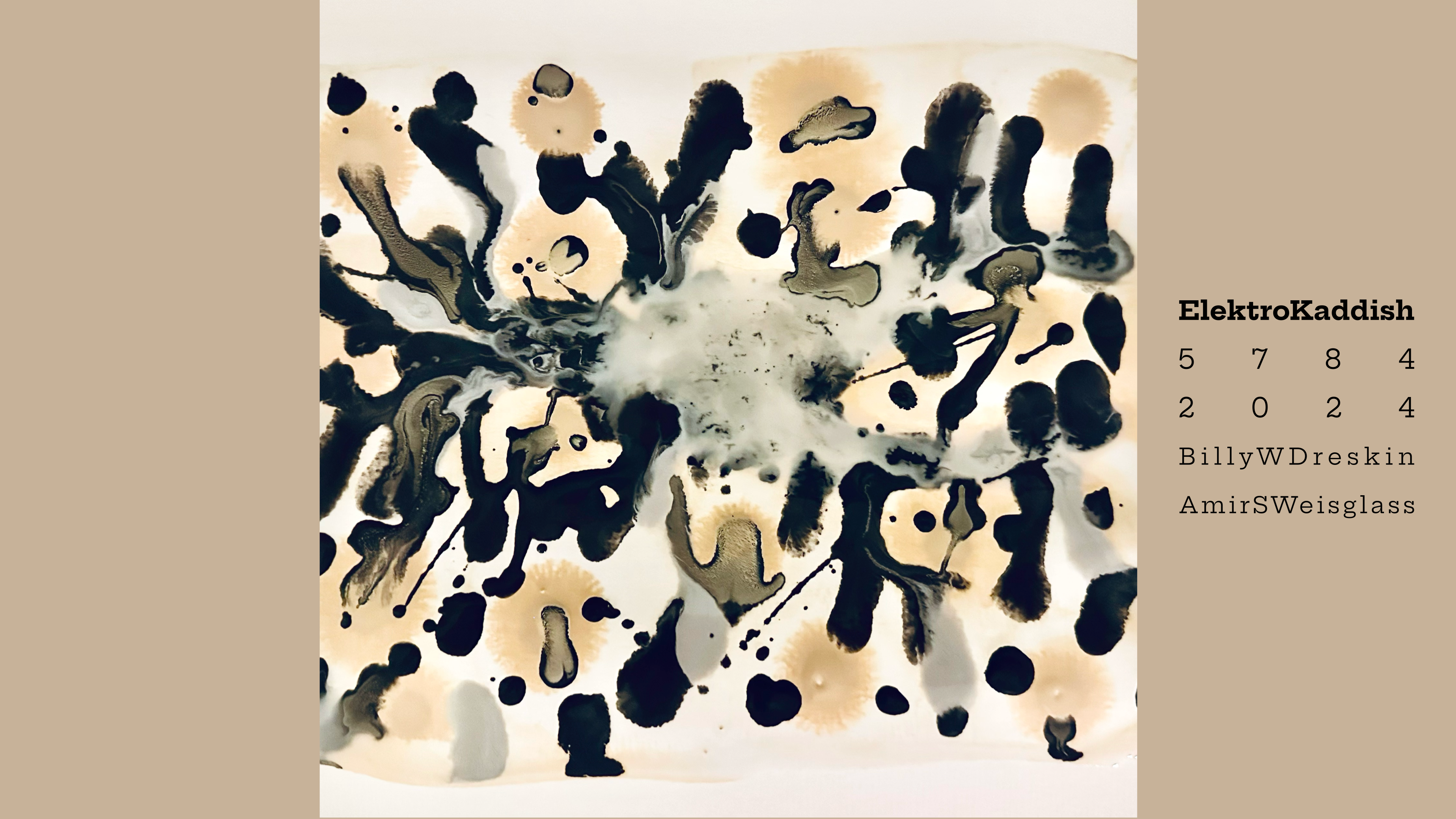
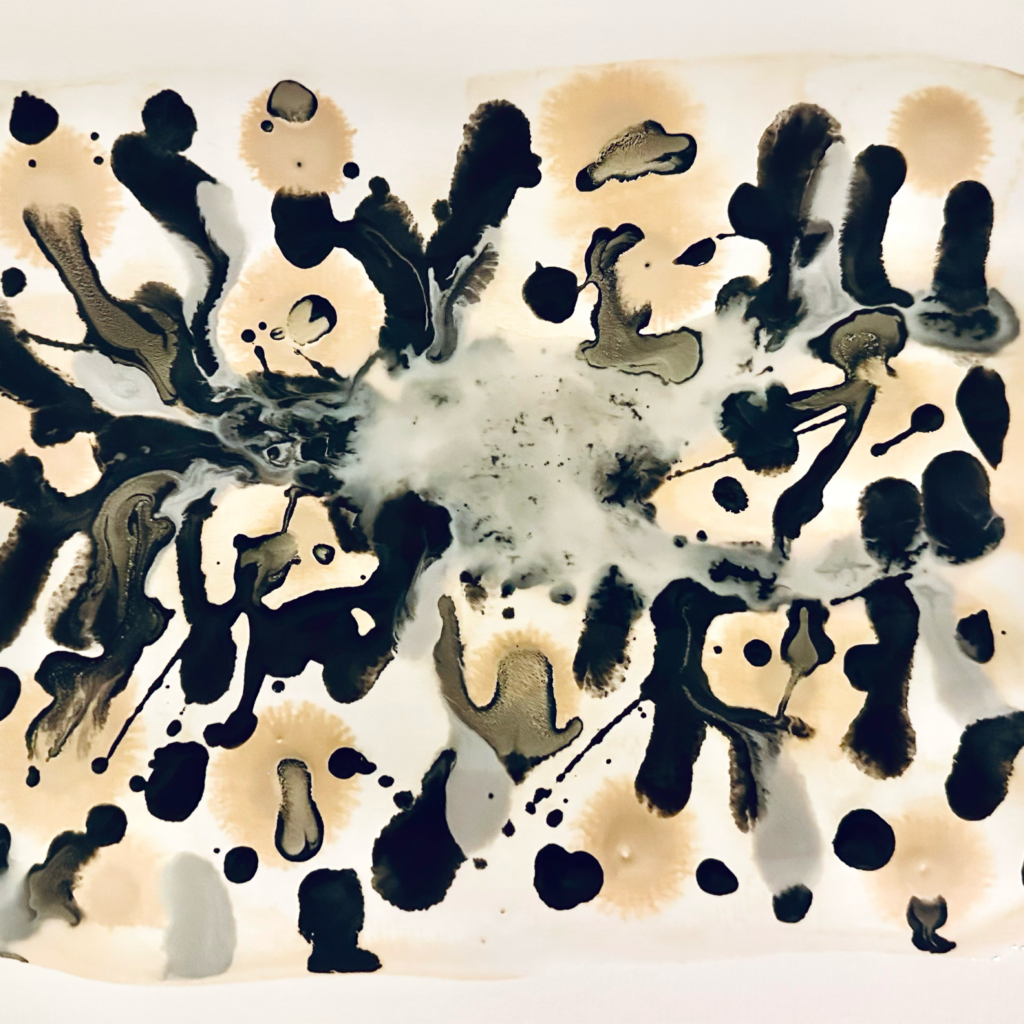
About his artwork for the song, Amir writes, “The image is part of a recent series of drawings I’ve been working on using ink, acrylic, and wall paint. I chose it intuitively after extensively searching for an image to accompany the song. The lyrics are profound and abstract, so an abstract approach to the image felt appropriate. Given that the text connects to the themes of life, death, and the entire circle of life, I immersed myself in the fluidity, flow and drip of paint. This allowed me to avoid committing to a single interpretation of the image of the music. Reflecting on it further, the tension between the electronic tools I used to create the music and bring it to you, and the manual, analogue work of the drawing and the music embodies the contemporary Holy Spirit. I am grateful for the ability to bridge the new and the old, merging electronics with analogue, and connecting the United States, Germany, and Israel today. The song and the image are my prayers for a better future.”
Thank you, Amir. I’m endlessly touched that you were moved to create this moving piece. While I doubt we’re going to make it onto the Top 40 this year, if nothing else your creation should be nominated for the Kaddish Music Hall of Fame. Yashir koach, chaver.
Billy
The sheet music and mp3 for my original “Kaddish” are available at Jonah’s Trading Post (https://jonahmac.org/product/kaddish). Your donation of any amount will be put to use in bringing the arts to others, effecting social change, and building Jewish life. The music is free – our way of saying thank you for being so nice.


 A cursory look online reveals that a lot of people write lists of hoped-for accomplishments. Some do it for themselves; many do so to teach others (or to get you to buy whatever life-improvement product they’re peddling). I looked over some of these lists and pulled out some that I thought were worth mentioning here.
 Once upon time, an anonymous rabbi was walking in the woods behind the dog park with his best pal, Charlie. He was soon joined by a man who lived nearby but who was born and raised in Ireland. The man was planning to go back and visit his brothers, two of a total of seven, who still live in Cork. But he couldn’t decide which brother to stay with. The very wise rabbi suggested he stay with whichever one will be less bothered by his choice. The man said that neither brother would be happy. The exceedingly wise rabbi suggested he invite both brothers to come stay with him. The man said that would never work. The increasingly impatient rabbi asked why. The man said, “Because my brothers haven’t spoken to each other in years.” The rabbi thought, “This is why I like dogs – they may never speak but they never stop loving either.”

 Here are three examples in real life where perceived defeat led to important new beginnings:
 Rabbis and cantors, on the other hand, are pretty much thinking about nothing BUT the High Holy Days. There is music to prepare, sermons to be written, and a thousand other preparatory activities that must get done before any of you set foot in the tent next Sunday evening.
 My summers, by the way, like yours, aren’t all vacation (tho I do remember those sublime years of youth when nothing needed to be accomplished between the last day of school in the spring and the first day back in the fall). My summer, slowed down as it was, included a half dozen funerals during which I was honored to share in the sacred act of saying goodbye to someone who was well-loved and will be much-missed. It’s always a privilege to be invited into these private, intimate, holy moments in people’s lives.
 • Lastly, bringing it all together, there’s Mars. Throughout June, July and August, the red planet came nearer to our earth than usual. Mostly residing about 140 million miles from Times Square, this summer Mars almost made it all the way up to Westchester, coming 100 million miles closer than ever! But what was most profound for me was that no matter where I was this summer: Massachusetts, Colorado or New York, there was Mars, shining brilliantly in the night sky. The lesson: Everything is connected, no one is alone, and we are all part of the same magnificent, unfolding story.
 2nd fun fact: 7% of all Americans actually believe that chocolate milk comes from brown cows. I don’t know if that’s true, but I’d bet it wouldn’t surprise many of you to learn it is (the 7% believing, I mean). This big, beautiful world of ours is filled with the full spectrum of humanity, including a few (what’s 7% of 325 million?) who think some pretty strange stuff. As the month of Elul nears its finishing line and we prepare to meet in the tent next Sunday to greet the New Year, may we embrace all of our human family, chuckling at those who subscribe to fun facts that are much more fun than fact, all the while extending our love and our compassion even to those from whom we differ immensely. Let’s resolve to make this New Year 5779 one of goodness, kindness, understanding, and the simple delight that comes from sharing the most magnificent fun fact of all: life.

 A horrific story of the Holocaust to share with you. Many of you will know it. Young people might not. But it describes just one small, terrible moment during which only three people died, which was pretty benign for genocide. All you have to do is multiply this moment two million times, and that gets you six million Jewish lives murdered by the Nazis during World War II.
 Here’s what happened. The Nazis occupied Albania in September 1943. When Adolf Eichmann called for the Final Solution to be implemented there, the Albanian response was a uniform one: “Besa.” Besa is a word that means “faith,” or “to keep the promise,” “word of honor.” It reflects the Albanian Muslim idea that when you have welcomed a guest into your home, you provide that guest every kindness and honor, withholding nothing, including, if need be, the protection of their lives. This concept extended beyond the walls of their homes to include the very borders of their nation. So when the Nazis came hunting for Jews, Albanian Muslims embarked upon an ambitious national project: to hide every one of them (including the additional 1800 souls who had sought refugee status there). Two thousand Jewish men, woman and children were protected. And except for a single family, two thousand survived.