Composed & Arranged by Billy Dreskin

the universe can always use more harmony

Love Is a Many-Splendored Thing

russian-coupleZeke and May had been married for over seventy years. Zeke was 101 years old and his wife was 99. One hot afternoon, as they sat together on their front porch rocking away, the old man, who was nearly deaf, couldn’t quite hear when May looked over at him and with admiration in her eyes said, “Zeke, I’m proud of you.” “What’s that you said, May?” She raised her voice and shouted in his direction, “I’m proud of you!” To which Zeke nodded and replied, “I’m tired of you too, May.”

Twenty-nine years a rabbi now, it’s hard for me to say just how many hundreds of wedding ceremonies I’ve presided over. I’ve used this story at only a couple of them. But what I can tell you is that I’ve loved being part of each and every one of those ceremonies. Many have been for kids I’ve watched grow up here, which has been very sweet indeed, while others have been for couples I’ve loved meeting and sharing in the excitement of their passionate and profound commitment to each other. And trying not to spoil their fun too much as I counsel them about the imperiled existence awaiting them just up ahead.

Tonight, being two days before Valentine’s Day, we’ve already listened to some of our fellow congregants share iyyunim on the theme of love. And as we’ve heard, love can encompass far more than a life-partner. Children, pets, even summer camp, can be among the many recipients of our heart’s devotion.

The human heart may occupy just a few meager ounces of space, but its capacity for love is possibly infinite. I asked myself the question – “What do I love?” – just to try and gauge my own heart’s capacity a little bit. I came up with a starter list that includes: my wife, my family, my work, this temple, my music (most music!), food (tho definitely not all food), nature, spending time in nature, reading books, apparently real books since I don’t enjoy Kindles, learning (especially Jewish learning), hi-tech gadgetry, compassion and generosity, smart people who have important things to say, and smart people whose important things that they say are effective and (even better) caring.

Oh, and my dog.

I’m sure I could quadruple this list if I spent more time on it. Which reminds me, let me add “time” to my list. I adore time!

This expanding of the list of what we love interests me. Not just our capacity to love, but our ability to expand that capacity, and to change how we feel. To add new items to the list. And most interesting of all, our capacity for adding items that we may have previously rejected, or even spurned. This, I think, is where we get Jewish about it.

One of the most fundamental texts in Jewish tradition about love is found in the book of Leviticus. In chapter 19, which is also known as the Holiness Code, we read: V’ahavta l’reyakha kamokha … love your neighbor as yourself.

Leave it to Judaism, of course, to offer such a fundamental commandment but make it next to impossible to fully understand. I mean, it looks simple. Love others! But what’s it really telling us? Love your neighbor as much as you love yourself? Love your neighbor in the same way you love yourself? And what if you don’t love yourself – are you allowed to treat others that way too?

The Hebrew kamokha, “as yourself,” can also be understood as “love the neighbor who is like yourself.” What does that mean? That people who are not like us, we don’t have to love them? Or is the Torah saying that it’s actually harder to love those who are similar to ourselves? You know, the guy at work who does pretty much what you do, so you kind of hope he fails. The woman who plays the same musical instrument as you – you’re so much better than she is. Or family, with whom we spend so much time that the opportunities for disappointment and resentment loom large. Moses Maimonides presumed this mitzvah was referring to how we treat other Jews. Which leaves us with a different question: Was the Rambam telling us that our responsibilities for love go no further than how we treat other Jews? Or is that just the place where love must begin?

And then to get weird, the Talmud understands “Love your neighbor as yourself” as meaning, “Choose for him a good death.” I mean, yes, I do want to have a good death … someday … but how did they figure this is the particular thing that God was talking about when we were commanded to love our neighbor as ourself? On the other hand, dying is among our most vulnerable experiences; we entirely rely on others to help us die. Perhaps that is indeed one of life’s most loving moments, when we make sure that a loved one can die in comfort and in peace.

One 15th century commentator, Isaac ben Moses Arama, suggested we look to the friendship between David and Jonathan. David was aspiring to become the king of Israel and Jonathan was the son of the current king, Saul, which either complicated Jonathan’s relationship with David or his relationship with his dad the king. A passage in the Mishna (Avot 5:16) reads, “Any love that is dependent on something, when that something goes away, so too does the love. While any love that is not dependent on something, it will never perish. That,” the Mishna concludes, “is the love of David and Jonathan.”

In our Book of Samuel class, we happened to have just read those passages. And while I can’t vouch for the depth of David’s love, Jonathan’s did indeed seem awesomely powerful. As the son of Saul, Jonathan was the crown prince, and he had every reason to be resentful of David’s aspiration to power, an upward trajectory that would prevent Jonathan from succeeding his father. And yet, not once does that factor into his words or deeds. Jonathan loves David, and nothing – even the loss of his kingship over Israel – would jeopardize those feelings.

I imagine that for 99.9% of the human population, love takes hard work and sturdy blinders. Which is why Jonathan is view with such awe by our tradition. I’ve been married to Ellen for 34 years. What that woman has had to put up with, it’s remarkable she didn’t kick me out decades ago.

It reminds me of a husband and wife who had been married for sixty years and had no secrets except for one. The woman had kept a shoebox in her closet that forbade her husband from ever opening it. When she grew very old and near to dying, she gave her husband her blessing to finally open the box. Inside, he found a crocheted doll and $95,000 in cash. His wife explained, “My mother told me that the secret to a happy marriage was never to argue. Instead, I should keep quiet and crochet a doll.” Her husband was deeply touched. After sixty years, whe corcheted only one doll? “But what’s all this money?” he asked. “Oh, that,” she said, “that’s the money I made from selling dolls.”

I am continually amazed at relationships that stand the test of time. I know that there’s so much more to them than the good times that were enjoyed together in the beginning and felt like the basis for staying together forever. I know that when real life gets added into the mix, and love still manages to remain, something very special, and very inspiring, has taken place.

Which brings me to the question of expanding our capacity to love to include what we may have previously rejected, or even spurned.

Many years ago, where Pumpernickel is in Ardsley, there used to be a restaurant called Tokyo Seoul. Our family loved eating there and went often. At the beginning of the meal, the server would place a number of small dishes in front of us, each containing a taste of some Asian hors d’oeuvres. One of these dishes contained kimchi, a fermented Korean cabbage that packed quite a spicy wallop. I didn’t much care for kimchi, but each time we went I ate a small bit of it. Over time, and I’m talking years here, I was able to increase the amount of kimchi I could tolerate. And today, I love it. I can sit with a full jar and just snack away!

LoveThyNeighborAsThyselfV’ahavta l’reyakha kamokha … love your neighbor as yourself.

What if you just don’t like them? What is they’re like an off-putting kimchi? Well, unless you subscribe to the notion that we’re commanded only to “love your neighbor who is like yourself,” our tradition doesn’t offer much of a way out. Either we perform the mitzvah, or we don’t.

When I was in college, I remember a fellow student who just rubbed me the wrong way. Our paths crossed many times during our years there, but I never gave her the time of day. For more than three decades, I carried that with me – not one of my prouder chapters. But a few years ago, I found her. And even though she now lives in the part of the world that invented kimchi, and I didn’t ever have to have anything to do with her again, I remembered that I’m Jewish and I’m supposed to try and live by at least some of the mitzvot. So I reached out to her, started a very long-distance correspondence and then spent some time together in-during a visit to the States. And you know what? It’s remarkable how much nicer she is thirty-five years later. Or could that be me? Well, either way, I’ve got a new pen-pal. And on a whole bunch of levels, it feels really good.

Which brings me to one more example – it’s of a completely unexpected love that came from a place of pure malice and hostility. I’ll never forget this story of a neo-Nazi by the name of Larry Trapp. In the early-90s, he was a Grand Dragon of the Ku Klux Klan who harassed a cantor by the name of Michael Weisser, threatening to blow up his temple in Lincoln, Nebraska. But Cantor Weisser responded in an extraordinary way. He reached out to Trapp with compassion and with a challenge: to talk with him, and to learn about the religion and the people he hated so deeply. In time, this neo-nazi befriended the cantor, and ended up converting to Judaism and joining the cantor’s synagogue.

I think that of all the love there is in the world, nothing could be sweeter than that of an enemy who becomes a friend. It is the most idealistic work for any of us to incorporate into our lives. It takes tremendous courage, and probably more than a little bit of stubbornness and chutzpah. I suspect that such attempts fail as often as they succeed, but all such efforts are noble ones. And when they do succeed, as with this one, their stories are unforgettable.

But I take it back – that may not be the greatest love. There is little doubt in my mind that the greatest love may very well be the one where – across huge tracts of time and even more moments of disappointment – individuals, or groups, manage to stick it out with one another. Despite letting each other down, neither walks away. I’m thinking of alliances between nations, or between disparate communities, among lifelong friends, relatives and, of course, between husbands and wives, between life-partners. Rabbi Larry Hoffman teaches about the honor of showing up each day to life. It’s hard enough when life settles into the ordinary and we wonder if that’s all there is. But then, when it gets rocky, to not walk away, to stick around and work things out if at all possible, that may be the highest fulfillment of v’ahavta l’reyakha kamokha.

So on this nearly-Valentine’s Day Shabbat, three cheers for love. Wherever it surfaces, however it steals our hearts, love is where it’s at. Zeke may have expressed an unfortunate truth in telling May he was tired of her too, but I’m guessing that he had no intention of going anywhere without her by his side. So in whatever form your Valentine appears this year, I hope that will be the same for you as well.

Don’t forget to bring home flowers!

The late-19th century writer Shalom Aleichem was a funny guy. He once wrote, “I never went to the fair without taking into consideration the feelings of my neighbors. If I was successful and peddled everything I took, and came home with my pockets stuffed with money, and my heart singing, I would tell my neighbors that I had lost all my money and was a failed man. The outcome of this was that I was happy and my neighbors were happy.”

Elohenu v’elohey avoteynu v’imoteynu … dear God and God of our ancestors … help us to better understand our family and our neighbors. Teach us to care about them kamokha, somewhere in the vicinity of the way we care for ourselves. Give us a “stick-to-it-ness” that will help us to ride out the rockier moments of our relationships. And expand the capacity of our hearts so that we might expand the list of those included in the sharing of our love. It’s cost-effective, fits any budget, and goes a long way to fulfill that long list of mitzvot You gave us at Mount Sinai.

Happy Valentine’s Day!

Thanks for Nothing (a Sukkot reflection)

maxresdefaultWhile procrastinating about writing for tonight, I watched what I thought was a pretty extraordinary and wonderful film called The Road Within. Released without much fanfare earlier this year, it’s about three teenagers – one with Tourette Syndrome, one with obsessive compulsive disorder and the third suffering from anorexia – who flee from their residential facility and embark upon the first great journey of their lives. I think what I love about this film is that these three teens, whose medical conditions are typically ones that debilitate an individual’s chance at having any sense of normalcy, set off on a road-trip which not only exacerbates their conditions but liberates them from constant enslavement to those conditions as well. Nothing goes away but, as the characters evolve, each tests the boundaries of what they can achieve in spite of their disability.

We’re finishing up the week of Sukkot, Judaism’s harvest festival and a time during which we wave the lulav, sniff the etrog, and spend time in the sukkah, all to celebrate and express our gratitude for God’s gifts. The ritual for waving the lulav has us do so in six different directions, the purpose of which is to affirm that God’s presence is everywhere, no place is devoid of the Divine.

That’s all well and good when life chugs along without disappointment or pain. And for a while, a lot of us get to live lives like that. But even for the most privileged among us – and by that, I not only mean materially but also physically and emotionally – time comes when we learn our lessons. It may wait til we get old and we learn that old-age hurts; it may come sooner when illness or setback or loss finds us and pushes our lives into a deep hole. But it does come. Eventually, we all learn what it means to live without.

In The Road Within, Vincent, who has Tourette Syndrome, complains, “This <bleep>ing sucks. Can’t I get one <bleep>ing advantage out of this <bleep>ing illness? [My tics] only come when I don’t want them and only in the worst <bleep>ing moments!” But Vincent soon discovers that he can live life, and he can do so with grace, with intelligence, and even with a smile. He may be a fictional character, but I’ve encountered him many times.

Franklin Delano Roosevelt, reelected President so often they had to pass a law to keep that from happening again, was paralyzed from the waist down by polio at the age of 39.

Oprah Winfrey was born in rural Mississippi to an impoverished, teenage single mom. She was raped at the age of nine, pregnant at 14, and lost a son during infancy.

Sylvester Stallone was a forceps-baby, complications from which resulted in the severing of a nerve that caused paralysis in the lower left side of his face, including parts of his lip, tongue and chin. This is what gave him his famous snarling look as well as slightly slurred speech. Truly, “a legend was born.”

And Marc Zupan, a paralympic Gold medal-winner in wheelchair rugby, he’s rock-climbed, sky-dived, and been a guest at the White House.

We all know someone whose life has been destroyed by something that plagued them. But we also know someone who rose above the worst that life had thrown at them, and prevailed.

201In the Talmud (Sukkah 23a), we’re taught that one may use an elephant as one of the walls of our sukkah. An interesting argument occurs there: “If he used an animal as a wall of the sukkah, Rabbi Meir declares it invalid and Rabbi Judah valid, for Rabbi Meir was wont to say, “Whatever contains the breath of life can be made neither a wall for a sukkah nor a side-post for an alley, nor boards around wells, nor a covering stone for a grave. In the name of Rabbi Jose the Galilean they said, “Nor may a bill of divorcement be written upon it.”

Pretty outrageous stuff, right? But it begs the question why one would even consider using an animal in any of these circumstances. Accusations of exploitation and mistreatment aside, I can imagine someone justifying this because they simply have no other options. And before you start yelling at me that no circumstances can justify mistreating animals, I am inclined to agree. But as often occurs in the Talmud, what they’re speaking about may not be what they’re speaking about.

Sukkot, as I’ve mentioned, is our gratitude holiday, our Thanksgiving. And much as we Americans consider it a fairly sacred national observance to prepare turkey and all the fixings, building a sukkah is the same kind of sacred (in this case, religious) observance for Sukkot. But if for Thanksgiving you can’t afford a turkey, what then? Families try to figure out some way to make Thanksgiving happen, whether it’s getting a turkey through the local food pantry or serving bowls of cereal because that’s all you’ve got and Thanksgiving needs to happen so cereal it is. The issue here, of course, is not Thanksgiving and it’s not the bowl of cereal; it’s continuing food-insecurity in America. When we hear about a family serving cereal for Thanksgiving, or even when we drop off our turkeys here at Woodlands for Hudson Valley Community Services to distribute to families living with HIV or AIDS, our minds (and our hearts) need to go to that next place, that next question: What do I do about the fact that there are people living in my community (in Westchester, for God’s sake!) who have nothing but cereal, or nothing at all, to serve at any meal in their home?

That’s what Sukkot is all about. And what that elephant holding up a sukkah is all about. If we can understand the blessings present in our own lives, then perhaps we can better see and respond to the lack of blessing in other people’s lives. A well-known Hasidic story has a rabbi imploring a very wealthy person to stop limiting their meals to bread and butter alone. “If you can survive on only bread and butter,” says the rabbi, “will you then assume the poor can survive by eating rocks?” Where we have blessing, our appreciation of those blessings can help ensure we don’t miss the blessing that is missing from other people’s lives.

Tonight, we’ve heard from five congregants who have shared their thoughts about the challenge of living these imperfect lives of ours and, despite the difficulties encountered along the way, the desire to (and sometimes, the success at) coaxing a sense of beauty and abundance right there in the middle of it all. It inspires me to hear from fellow journeyers that others are figuring how to feel grateful for life’s goodnesses even while struggling with its adversity.

20140405114919-campfire-picEarlier this evening, before the Silent Prayer, we read the words of Noah benShea, reminding us that during our efforts to “build a fire” in our lives, we sometimes have to scratch at the ground “hoping to find the coals of another’s fire,” but all we come across are ashes. While some will crumble in despair because no light, no warmth remains, others will be comforted by their understanding that “somebody else has bent to build a fire,” “somebody else has carried on.” That too can be a blessing.

When my son Jonah died at the age of 19, it felt for a while as if my life was over. I was emptied out, broken-hearted and irretrievably lost. In time, however, I began to remember all the goodness that had been Jonah’s life, his antics, his energy, his kindness. And though I will never cease missing him, I will scratch at the ashes on the ground, forever grateful that I got nineteen amazing years to experience him and to love him. Each Sukkot, I remember how he always jumped in to help us build our family sukkah. His spirit was delightful, uplifting and inspiring.

I won’t say I’ve mastered the art of expressing gratefulness for life’s bounty even when that bounty eludes us, but I’ve definitely gotten better at it. And while unfortunately life provides each of us with opportunities to practice gratitude-amidst-hardship, it also showers us with an embarrassing abundance of riches-without-any-cost-other-than-being-human, for which I will always be practicing my thank you’s.

The traditional greeting during Sukkot is “Moadim l’simkha,” which means something like, “May the moments in your life always place you on a path that brings you to a deep, abiding sense of joy.”

Moadim l’simkha,
Billy

P.S. Thank you, Joshua Spodek, for writing about People Who Succeeded Despite Adversity.

And just in case you’d like to read a bit more, here’s a poem written by W.S. Merwin, an American poet who was particularly prolific during the 60s anti-war movement. He lives in New York City and is 88 years old. This is entitled “Thanks.”

Listen
with the night falling we are saying thank you
we are stopping on the bridges to bow from the railings
we are running out of the glass rooms
with our mouths full of food to look at the sky
and say thank you
we are standing by the water thanking it
smiling by the windows looking out
in our directions

back from a series of hospitals back from a mugging
after funerals we are saying thank you
after the news of the dead
whether or not we knew them we are saying thank you

over telephones we are saying thank you
in doorways and in the backs of cars and in elevators
remembering wars and the police at the door
and the beatings on stairs we are saying thank you
in the banks we are saying thank you
in the faces of the officials and the rich
and of all who will never change
we go on saying thank you thank you

with the animals dying around us
our lost feelings we are saying thank you
with the forests falling faster than the minutes
of our lives we are saying thank you
with the words going out like cells of a brain
with the cities growing over us
we are saying thank you faster and faster
with nobody listening we are saying thank you
we are saying thank you and waving
dark though it is

To which I add Anne Frank’s immortal words, “In spite of everything.”

W.S. Merwin’s poem is published in Migration: New & Selected Poems (Copper Canyon Press, 2005).

Elul: Preparing to Forgive … Others, and Ourselves

The 19th century German poet and essayist Heinrich Heine once wrote, “All I ask is [for] a simple cottage, a decent bed, good food, some flowers in front of my window and a few trees beside my door. Then if God wanted to make me wholly happy, He would let me enjoy the spectacle of six or seven of my enemies dangling from those trees. I would forgive them all wrongs they have done me – forgive them from the bottom of my heart, for we must forgive our enemies. But not until they are hanged!” (as quoted in Edge-Tools of Speech,1899, Maturin Ballou, p. 169)

Recalibrate‘Tis the season. In a little more than a week, we’ll enter our tent, open our makhzorim, and begin our annual period of reflection and contrition, with the goal of teshuvah, of recalibrating our hearts that we might become more compassionate – to others and to ourselves – in the New Year ahead.

I’m not at all clear how these High Holy Days actually affect us. I do, every now and then, encounter someone who, prior to the arrival of Rosh Hashanah, offers me an apology for anything he might have said or done that hurt or offended me. But I’m not impressed by that. I don’t think that’s teshuvah at all. There’s no turning, no recalibrating, going on because there’s no knowledge of having done anything wrong. “If I’ve done something, I’m sorry”? Better to find one person we know we’ve been unkind to and put our New Year’s energy into fixing that one relationship. It takes courage to confront someone we’ve wronged, to apologize when we know we’ve behaved poorly. To issue some blanket memo to try and cover our bases neither warms the heart of the person we have wronged, nor teaches us any lesson about ourselves … except maybe that we don’t care enough to really figure out where we’ve fallen short.

The upcoming Y’mei Aseret Teshuvah, the Ten Days of Turning from Rosh Hashanah through Yom Kippur, are not meant to be easy. But for most of us, that’s pretty much what they are. Our greatest challenge is to make it through the fast on Yom Kippur. I’m not sure that many of us really do the difficult soul-searching that’s demanded by the texts in our makhzor. I’m not sure we do the real forgiving that these High Holy Days challenge us to do.

Me and my big brother (well, 1 of 4 anyway)

Me and my big brother

A few weeks ago, I spoke about my brother Jimmy and how he’s my hero. I joked about the scar he’d given me when I was six and he was eight and he’d chased me through our house threatening to smash a wet noodle in my hair and I ended up crashing through the plate glass of our front door. When, some fifty years later, I learned that he still feels guilty about that, I shared with you how I take full advantage of his guilt which, most recently, resulted in his coming up from Florida and repairing just about every broken hinge, light and damaged wall in my home.

The reality … is that I forgave him a long time ago. But that was easy. He’s my big brother. And I worship him. And adore him. I could never hold a grudge against him.

Unfortunately, it gets easier where others are concerned.

Rabbi Nakhman of Bratslav, the late-18th century founder of the Bratslav hasidic community in the Ukraine, noticed how people hold grudges, how our anger can cause us to push someone completely away and out of our lives without any interest in repairing the rift but, instead, concluding there is nothing redeeming in that person and there is no value in trying to make amends.

To try and counter such behavior, Reb Nakhman wrote: “[For] even someone who is completely wicked, one must search and find in him some little bit of goodness, because within that one little part of him, there is no wickedness.”

When I first read this, I was thinking of truly evil people like Caligula or Hitler. With the likes of such mad men, it’s easy to write them off as monsters. It hadn’t occurred to me that, when we’re angry at someone who’s not a Hitler, we can paint that person as if they are completely awful, possessing no redemptive features whatsoever. In our saner, more sanguine, moments, we understand we’re not talking about Caligula; it’s just that idiot Bob from work, or my dumb neighbor, or my sibling with whom I haven’t spoken in fifteen years.

Reb Nakhman urges that we: “find in him a little bit of good, judge him on the side of merit, and in this way, raise him up and enable him to turn in teshuvah.”

I may be reading this wrong. But the teshuvah here, the turning, I don’t think it’s Bob’s. It’s ours. Yours and mine. When we’re furious at someone, we need to find a tiny crack in the armor we’ve built around that other person – armor that shows (and defends) only what we hate about them. Reb Nakhman teaches that we need to see the whole person, not just the parts we resent. We need to come to understand that, despite our brilliantly deduced conclusions, people are salvageable.

31171364524726_I-never-use-a-turn-signal-Its-nobodys-freaking-business-where-Im-goingUnlike my attitude toward drivers who don’t use their turn signal, and I wish horrible things upon them because of the danger they create by not letting other drivers know their intentions and therefore reduce our ability to react safely to an unsafe moment on the road. At those moments, it could be Malala Yousafai and I wouldn’t be able to see a single redemptive quality in her.

Reb Nakhman says about the one we resent, that we should ask ourselves: “How is it possible that she never fulfilled a single mitzvah or good deed in all her days?” Reb Nakhman teaches that when we push ourselves to look for the goodness that resides somewhere inside each one of us – even my annoying neighbor who blows his leaves at 6:30 on a weekend morning – when we succeed in finding those redeeming qualities, then redemption can begin. Our redemption.

Despite my behavior behind the wheel, sometimes I’m amazed at my capacity to forgive. My brain continues to argue with me, “Are you kidding?” it shouts. “You’re going to let them off the hook for what they did to you!?”

And my answer is: Yes. I am. Because life is a whole lot bigger than stupid, annoying, hurtful moments. I’ve got better things to do with my time. Life is far too short to spend it pursuing resentment and rejection.

Shlomo Carlebach, who’d fled the Nazis as a young man, was once asked how he could go back to Austria and Germany to perform. “Don’t you hate them?” he was asked. Carlebach responded, “If I had two souls, I’d devote one to hating them. But since I have only one, I don’t want to waste it on hating.”

Rabbi Rami Shapiro challenges us to view Rosh Hashanah as “head-changing day.” He derives this from “head” (rosh), and “changing” (shay-nah, a variation on HaShanah).

“You can’t have a new year with an old head,” he writes. “So if you want a new year, you are going to need to get a new head. A new head is a story-free head. Your stories define you. If your stories are positive and loving, then you are [positive] and loving. If your stories are negative and fearful, then you are [negative and fearful].”

Rabbi Shapiro encourages us to rewrite our stories. To focus on truth. And to focus on compassion. To cast away the stories that frustrate us, that anger us, that make us turn away from others.

It is the 21st day of Elul. Soon we will gather for our Rosh Hashanah and Yom Kippur heshbon nefesh, our annual soul-searching. May the year 5776 be the one in which we truly master the art of teshuvah. May we turn our spirits toward You, God, by turning them away from bitterness, resentment and hatred. May these Ten Days of Turning bring real change. To our heads, to our hearts, to our spirits. And may we share together in a New Year that is filled to overflowing with kindness, tolerance, understanding, radical inclusion, and love.

Billy

The Honor of Being Alive and Part of Creation

The-Night-Sky-by-Eric-HinesHolmes and Watson go on a camping trip. After dinner and a bottle of wine, they lie down for the night and go to sleep. Some hours later, Holmes wakes up and nudges his faithful friend. “Watson, look up at the sky and tell me what you see.”

Watson replies, “I see millions of stars.”

Holmes: “What does that tell you?”

Watson ponders this for a moment and then responds, “Astronomically, it tells me that there are millions of galaxies and potentially billions of planets. Astrologically, I observe that Saturn is in Leo. Horologically, I deduce that the time is approximately a quarter past three. Theologically, I can see that God is all-powerful and that we are small and insignificant. Meteorologically, I suspect we will have a beautiful day tomorrow. What does it tell you, Holmes?”

Holmes is silent for a minute, and then speaks. “Watson, you idiot. Someone has stolen our tent!”

How unlikely an honor it is that we have been created at all, that we are living life, and that we are living it as a next chapter in the continuing story of the Big Bang.

While, from time to time, it becomes necessary to focus on minute details of our individual stories in order to survive, it is our connection to the meta-story of life that I’ll be writing about – how big we are, even as an infinitesimally small piece of the universe.

Just the other day, someone asked me not to jinx them by saying so-and-so. I looked at them incredulously, which a rabbi really ought not do, but I was stunned to witness firsthand that superstition is alive and well in the 21st century.

A study that was published in the Journal of Experimental Psychology found that when college students were asked to say out loud that they would definitely not get into a car accident this winter, follow-up questioning ascertained that they definitely thought it more likely that they would. When subsequently asked to “knock on wood” on a table in front of them, the effects of the jinx were believed to have been reversed; these students were no more likely to think they would get into an accident than those who hadn’t jinxed themselves in the first place.

We humans, no matter how well-educated we are, are very reluctant to let go of our primordial fears. Not only do we hang onto to age-old superstitious beliefs – black cats crossing our path, walking beneath a ladder – we’re creating new ones all the time: sports players who pitch or bat well at a game, then try to maintain their success by wearing or doing some repeated act for each subsequent game; candy consumers who avoid certain M&M colors believing they might cause illness or the risk of terrorist attack. There is no end to our beliefs in supernatural forces acting on our natural world.

Perhaps the best-known act of superstition is prayer. The ancient Israelites believed that Rosh Hashanah and Yom Kippur were necessary preliminaries leading up to the most important prayer-day of their year: Sukkot, during which they prayed to God for rain. In a few weeks, we’ll gather in our tent and, while praying for no rain during the High Holy Days, many of us will ask God to forgive us for our sins from the previous year. Along the way, we may ask for a few boons as well: healing for a loved one, a raise at work, maybe even a curse or two for our annoying neighbors.

prayerNot infrequently I’m informed that someone no longer believes in prayer because God never seems to be listening; that is, God doesn’t grant the requested favor. But that’s not the main purpose of prayer – not in the Jewish tradition, not in any religious tradition.

Do you know the story about the man who is sitting at his wife’s bedside at an out-of-town hospital they have unfortunately had to come to while traveling? A local rabbi invites the man to attend his synagogue while he’s in town, to which the man responds, “Rabbi, if I have anything to ask of God, I can do that right here.”

Certainly when our loved ones are not well, we pray for their recovery. And we would welcome God’s altering the course of nature, if necessary, to grant our loved one a miracle. But traditional prayer is neither about our asks nor the granting of miracles. Prayer is about acknowledging the magnificence of life and expressing thanks that we’re part of it. Rather than bending God’s will to our own (a fairly presumptuous thing to do), prayer encourages us to align our desires with God’s. The end of the hospital story is the rabbi saying to the man, “Well, perhaps God has something to ask of you.” The universe is huge, infinite. Prayer expresses our gratitude and our awe at how lucky we are to be part of it. Especially in light of the improbability of life existing on earth in the first place.

photosynthesis-3In the earliest chapters of earth’s history, there was no oxygen in our atmosphere. The sun’s rays did create a bit of oxygen by splitting it off from carbon dioxide and other molecules, but the oxygen molecules quickly disappeared when they formed bonds with others, transforming into compounds like rust and hydrogen peroxide. It wasn’t until some three billion years ago, when microbes evolved the ability to perform photosynthesis, that oxygen became abundant, and you and I became possible.

Prayer is the human response to that unlikely event and the subsequent evolution that has brought you, me and everything we love into existence.

This past Monday, I stood at the graveside of a congregant’s grandmother as we laid to rest the sacred vessel in which she had lived her life. Before we left the cemetery, we joined together in reciting Kaddish. As always, I shared with those gathered that their isn’t a single word in the Kaddish prayer about death. Kaddish is a grand poem in which we proclaim two truths: the first, that life is an extraordinary gift to each of us; and the second, that the appropriate response to that gift is thanks. With Kaddish, we thank God for a universe in which life is possible, and how grateful we are for having shared in the life of this person whom we have loved and whom we now return to the infinite ocean of life from which we all emerged.

On Rosh Hashanah morning, shortly after we’ve first opened the pages of our new High Holy Days makhzor, Mishkan HaNefesh, we will read these words:

“My Lord is not a shepherd and I am not His sheep. No monarch greedy for my praise is worthy of my prayers. Oneness that exploded into cosmos, spun the double helix over eons of evolution, made all things beautiful in their time, gave me intellect and initiative to envision Oneness: a single chain of life, a single human family, and myself one part — responsible and responsive, member of a people who dreamed of Oneness, worked and suffered for its sake, and still lives in service to that Unity: This I honor. This I hold sacred.”

Now that’s prayer. In a world whose mechanics we increasingly understand, the awesomeness of the Force responsible for its existence only grows more impressive. While I am quite sure you and I will continue to knock on wood when someone we love is in peril, let us try and remember how great the universe is, and to never withhold our profound thankfulness for having the magnificent honor of becoming one tiny share of that infinite magnificence.

As we continue our Elul preparation for the upcoming Days of Awe, let us remember that while we are but dust and ashes, we are also but a little lower than angels.

lithium-setRadiolab is a nationally syndicated radio program produced by WNYC that focuses on topics of scientific and philosophical nature. In the episode, “Elements,” they focused on a young woman diagnosed as having bipolar disorder and whose successful treatment involved the administration of three tablets of a salt called lithium. Besides how effective lithium is in treating the young woman’s condition, the program explores the fundamental, essential character of the drug; lithium is an element, an atom, not a complex drug – it appears on the Periodic Table of Elements and has been around since the Big Bang.

Ben Lilly, who writes about psychiatric drugs, found this to be a “profound reminder that the forces that shape everything in the universe are the same as the forces that are shaping who we are.”

Eloheinu v’Elohei avoteinu v’imoteinu … dear God and God of our ancestors …

How did we manage to wind up on the invitation list to this cosmic gathering? Why have You included us as part of the continuing story of the Big Bang and Creation? We may never know. But thank You – for whatever it was You did to get us in the door.

May we live our lives in such a way as to be worthy of being part of it all.

Billy

Zero to Hero

Me and my big brother (well, 1 of 4 anyway)

Me and my big brother (well, 1 of 4 anyway)

My brother Jimmy came up from Florida last week to spend time with me and my family. Jimmy is number five of the six Dreskin children. I’m number six. We’re two years apart. Much of my childhood was spent fending off attacks – both physical and psychological – from Jimmy. When I was six, he sent me flying through our all-glass front door bestowing upon me a wrist-to-elbow scar that has been ever-so-useful, to this day, in prompting his guilt-ridden conscience to do pretty much anything I ask of him.

So, for seven days this past week, Jimmy fixed things around my house. And since he used to build houses for a living, he can pretty much fix anything.

But here’s the problem. He fixed things a little too well. Our bathroom door, which used to require powerful effort to move it along the carpet in order to open or close, is now damaging my dresser when I push it too hard and it flies above the carpet only to be stopped by what used to be the beautiful finish of our bedroom furniture. Same with the bathroom mirror. It used to not even close but now, held firmly in place by a strong magnet, my pull to open it sends it careening into the adjacent wall. And then there’s the secret annex, a collection of shelves that is home to many family photographs but whose existence hides a storage space behind which we keep our Shabbat paraphernalia, cookbooks and more. The shelves used to require a rather Herculean effort to lift and simultaneously pull the unit open. Now, thanks to my brother, a simple, gentle tug will access its interior. But since my brain’s neuron-firings haven’t yet learned that, I continue to lift and pull which sends the photographs flying across the room.

I say this all not to complain about my brother. Although that’s always fun. To the contrary, I am in awe of his abilities. And after helplessly standing by as, year after year, more parts of our home whither and atrophy, Jimmy’s prowess at restoring hinges and catches and the like makes him nothing less … than my hero. Ellen’s delight at walking into our kitchen and having a flood of light replace the dim shadows she’s cooked in for two decades is all the reward this husband ever needs.

Which got me thinking about heroes.

hero_03We all grow up, I think, with pretty clear ideas of what makes a hero. Heroes save lives. Heroes sometimes sacrifice their own to do that. They certainly put their own welfare last when it comes to helping others. War heroes like Gen. George Washington in the Revolutionary War, Maj. Eddie Rickenbacker in World War I, and Lt. John F. Kennedy in World War II, conjure up magnificent images of brave men risking it all to save others. When 9/11 occurred, firefighters and police officers became our heroes as we watched them run into falling buildings to rescue those trying to get out.

Recently, we have seen heroes work their magic in ending the Ebola outbreak in Africa, aiding victims of the earthquake in Nepal, and fighting the flames of major fires out west. These folks do the work that needs to be done if lives are to be protected, but is work that neither you nor I can nor (probably) would want to do.

Jewish tradition has its heroes too. Noah saved the remnants of global destruction. Abraham risked the wrath of God to challenge the Divine’s decree against Sodom and Gomorrah. Esther knew her place but stepped away from it in order to reverse a king’s edict for genocide. Young David felled the mighty Goliath. And the prophetess Deborah led successful military campaigns against Israel’s enemies, freeing Israel from oppression beneath the yoke of Yavin, king of Canaan.

Tzedek, tzedek tirdof, the Torah teaches us. “Justice, justice you shall pursue.” Paving the way for myriad heroes to arise from our own ranks effecting social change for the better in all corridors of human life.

And so we’ve seen Jews step up and be counted in so many different heroic ways. In 1964, Andrew Goodman gave his life in the struggle for civil rights. In 1952, Dr. Jonas Salk developed the first successful polio vaccine. In 1776, Polish-born American-Jewish businessman Haym Solomon was possibly the prime financier of America’s involvement in the Revolutionary War. In the early 1900s, Julius Rosenwald, co-owner of Sears and Roebuck Company, established a fund that helped build nearly 5000 public schools for America’s black children. Film director, producer and screenwriter Steven Spielberg not only brought us “Schindler’s List,” but, in 1994, created the USC Shoah Foundation Institute which has recorded and preserve testimony from nearly 52,000 Holocaust survivors and other witnesses.

The list goes on and on. And on. And on. And on. Our measly 1/4 of 1% of the world’s population has effected immeasurable change for the better throughout the world.

Had to wander back through time a bit to get all the Dreskin men in one photo (my wedding, 1982!)

Had to wander back through time a bit to get all the Dreskin men (and then some) in one photo (my wedding, 1982!)

And then there’s you and me. During his week with us, Jimmy was telling me how he’d done nothing of importance with his life. It’s a Dreskin trait, especially among the Dreskin men. My father, a much-loved physician in Cincinnati, always lamented that he’d not won a Nobel Prize in medicine. As a kid, Jimmy had dreamed of becoming a nuclear physicist. While he had the brains for it, he lacked the ability to sit still and do the hard studying to get there. And me? I look at rabbis like Gordon Tucker in White Plains, David Wolpe in Los Angeles, and Rick Jacobs at the URJ, and, like my father, I too lament what I have not become.

Do you suppose I was listening when I said to my brother, “Are you kidding me? Look at your life. Look at the beautiful, loving, giving children you’ve brought into this world. Look at the home you’ve built for them, a space in which they grow, safe and loved. And look at the good you’ve done for so many by making their electricity work, their roofs not leak, their doors and windows open and close, and a thousand other ways that you improve other people’s lives. Believe you me, when you get the lights working or fix the heat in one of the homes you’ve visited, you’re that family’s hero.”

Maybe I’m stretching the definition a bit. I don’t know if we have to risk limb and life in order for others to place us in that superlative category. Sometimes a quiet conversation when someone is troubled can leave that person feeling like their life has just been saved. Even a student who’s got a paper on ancient Greece due in three days and, not knowing how to get the work done, is calmly ushered through by a teacher or a mentor who simply takes the time to help – that’s a hero.

My wife Ellen’s mom is 93 years old. She’s blind and suffers from dementia. Other than that, she’s been nearly as healthy as a horse. But this summer, her body put her through the wringer and it didn’t look like she’d be around much longer. Ellen and her sister Claudia tended to their mom around the clock, sometimes trying to save her life, sometimes just trying to make what appeared to be the end a bit more comfortable. It was exhausting work for them. To me, it was heroic. What a gift, whatever the outcome, that they gave to their mom. A gift of profound love during this late chapter of her life.

Even when the photographs of Pluto began streaming back to earth from three billion miles away this summer, I very proudly made one of them the feature image on my phone, so grateful was I that some team of rocket scientists and computer geeks had figured out how to show us a piece of creation that resides so far away.

I’m pretty enamored of heroes. And I try to stay open to every possibility for meeting new ones.

Hanging in my home is a framed piece by artist Brian Andreas who draws somewhat goofy but delightful cartoons accompanied by pithy words. This one reads: “Most people don’t know that there are angels whose only job is to make sure you don’t get too comfortable and fall asleep and miss your life.” Ellen, one of the wisest people I know, put the Andreas piece on our wall. It reminds us both that the world is an amazing place and that there are equally amazing people living in it. We ought never get so busy nor so preoccupied with ourselves that we can’t find time to be amazed. Hence, the Pluto pictures on my phone.

Kohelet wrote, Ein kol hadash takhat hashamesh … there’s nothing new under the sun. While many read this verse as an excuse to be blase about everything because, after all, we’ve seen it before, Kohelet’s point was quite likely the opposite. Stay awake. Stay alert. The world never stops being amazing. And if you think it has, you’re missing out on the best life has to offer.

To see as heroic the sandwiches a young parent makes for a kindergartner’s first day of school … makes the world a bright, interesting, affirming and wonderful place. To see as heroic the young idealist who licks envelopes so that others can receive and learn about the candidate this kid thinks will be great for our community … warms our hearts and fills us with hope that a new generation is going to do what they can. And yes, to see as heroic the efforts of a big brother who once scarred his bratty kid brother for life and now fixes his doors and cabinets so that they move freely for the first time in years … why not?

courage-capeTo love and appreciate because someone can – you fill in the blank – administer a life-saving drug, cook a nourishing meal, teach a curious child, give a warm, loving embrace, are these not among life’s most spectacular moments? And are these people – you, me, the members of our families, our friends, our neighbors – not performing heroic deeds by simply showing up to life each and every day, doing the same, un-famous things year in and year out, and being loved for it as if we were world-acclaimed celebrities?

My teacher, Rabbi Larry Hoffman, writes about wrinkles and how they are the marks of a life that’s been lived. It’s up to you and me to decide whether it’s been well-lived. But we get credit – lots of credit – for just showing up. True Dreskin that I am, I lament the accomplishments that I haven’t achieved. But then I look at you, at this beautiful, sweet, holy community, and I thank my lucky stars that you believe I have enough to offer that you invited me and my family to move in with you twenty years ago.

Ein kol hadash takhat hashamesh … there’s nothing new under the sun. But we can, and ought to, renew how we look at everything under the sun. It may not be new. But our appreciation of it might be.

I really am in awe of my brother’s abilities to improve the space that a person lives in, to make it lovelier and more functional. Can a million other people do the very same thing? Absolutely. But for the folks who creak front doors he is invited to walk through, Jimmy is the most important of them all.

Someone else will treat the illnesses. Someone else will put out the fires. But for those who are lucky enough to have you and me step into their lives and make a sandwich, explain something confusing, give a hug, even fix a broken light switch – we too can be their heroes.

Let’s just be sure we don’t get too comfortable, fall asleep, and miss out on the excitement.

In 2012, astrophysicist Summer Ash underwent heart surgery to replace a defective aorta. Upon her recovery, Summer discovered that her heart had developed certain acoustic anomalies that resulted in her heartbeat becoming audible to the naked ear. She, and others sitting close to her, could hear the steady beating from inside her chest, not through a stethoscope but from the heart itself.

Through this odd experience, Summer Ash achieved a level of recognition of her heart’s purpose. With her engineer’s brain, she understood the heart as a pump. But as a human being with this unique experience of living with her own audible heartbeat, always, she came to appreciate the work our hearts do to keep us alive, every minute, every day.

A different kind of hero, to be sure. But with the same message, I think … to not miss out on our lives, and to give thanks for the great gifts that are bestowed upon us … every minute, every day.

Billy

The Phone Lines of Human Connection

Woody Allen once said, “In California, they don’t throw their garbage away. They make it into TV shows.”

While much of television really is mindless drivel, we certainly love it. It’d be good to limit how much we watch, lest our brains melt into Velveeta Cheese, but even I love to occasionally relax and enjoy the view.

There are those who say that watching television cuts us off from human contact which, while that can be true, doesn’t have to be. I can tell you that the television set is where my son Aiden and I find common interest and time together. And, of course, documentaries can teach us about our world and inspire us to join with others and work to better life for ourselves and for others.

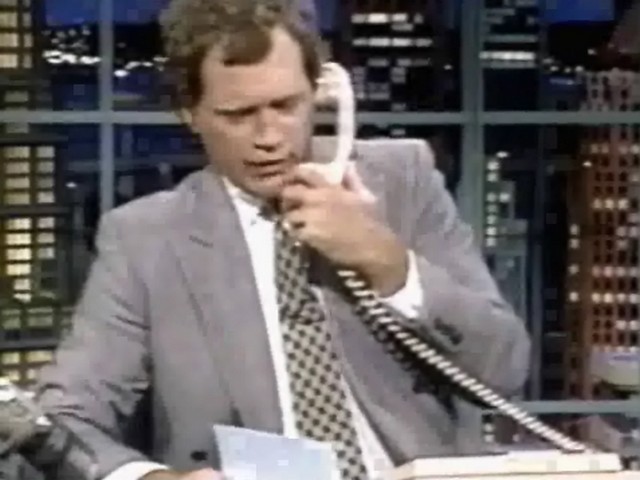
1990. Dave calls his mom, but reaches Sid Tuchman instead.

1990. Dave calls his mom, but reaches Sid Tuchman instead.

Tonight, however, I have in mind Late Night with David Letterman which, after 33 years on the air, played for the last time on May 20. That was a good episode but not the one I want to talk about.

On July 31, 1990, almost twenty-five years ago, Dave picked up the phone to call his mom during the show, which he did from time to time. But on this particular occasion, Dave dialed the wrong number. Who he got became one of the funniest Letterman bits ever. And to this day, many believe the whole thing was staged. I have information to the contrary. But first, here’s Dave, trying to call his mom, and getting Sid Tuchman instead:

http://www.youtube.com/watch?v=HZ2cAuSj-2Q

So Dave’s mom knew Sid Tuchman. Why? Because Sid Tuchman owns a network of dry cleaners all over Indianapolis. Lots of people knew Sid Tuchman, including Dave’s mom.

But guess what? I knew him too! After all, I grew up in Cincinnati. Indianapolis wasn’t far from where I lived. And guess what else? In high school, I dated Sid Tuchman’s daughter. Well, I’m not sure you’d call it dating. It was a summer camp romance. For one summer, back in the mid-70s, at the URJ Goldman Camp outside of Indianapolis, Sid’s daughter, Kathy, swept me off my besandaled feet and my heart was hers. Truth is, and I hope Ellen won’t poison my food for this, part of my heart still is hers. First big romance ever – that one kind of never fully goes away. She and I have remained friends across the decades and, even though she lives in California, I’m actually going to see her in just a few weeks when she’s in town for business. We’re going to share a good laugh over my recent awareness of the Letterman-Tuchman video and that I gave a sermon about it!

Well, I haven’t given the sermon yet, but here it comes now!

Paper dolls

David Letterman’s connection with Sid Tuchman was quite the surprise to him, since he was expecting to reach his mom. I think that the sermon – the lesson for us – is that unexpected encounter offers new relationships and meanings. I believe that, like that phone call, there are points of contact between us and others that come as a complete surprise and go on to become significant in our lives. This video, a case-in-point. Such momentary intersections between ourselves and others can have myriad affects on us. They can make us laugh, make us cry, and make us wonder in amazement at the magic and the mystery of its even happening in the first place. If you’ve ever bumped into someone who you’ve not seen for the longest time, perhaps you’ve felt that surge of wonder and wizardry that accompanies such surprising encounters. And if it hearkens to something good (and mind you, I’ve also bumped into people who I wouldn’t have minded never seeing again), these moments can deepen the beauty and value of being alive and of simply going along for life’s ride.

But there are some points of contact that don’t often appear in our field of vision and experience. We only encounter them if we make the effort to do so. We have to want these points of contact and we must coax them from out of the fabric of life.

I’m speaking of what the Torah frequently makes reference to as “the orphan, the stranger and the widow,” categories which indicate people who don’t usually circulate within our sphere of living but whose welfare depends on our interest in making that happen. Exodus, chapter 23: “V’ger lo tilkhatz … you shall not oppress a stranger … v’atem y’da-tem et nefesh ha-ger … for you know the feelings of the stranger … kee gerim he-yee-tem b’eretz Mitzrayim … having yourselves been strangers in the land of Egypt.”

Extending a helping hand to others who are in need is a well-known and deeply-held value of Jewish life. But it only happens if we allow it to happen.

A Nepali man carries recovered belongings through the street in the ancient city of Bhaktapur in the Kathmandu Valley on April. 28, 2015. Nepal had a severe earthquake on April 25th. Photo by Adam Ferguson for Time

A Nepali man carries recovered belongings through the street in the ancient city of Bhaktapur in the Kathmandu Valley on April. 28, 2015. Nepal had a severe earthquake on April 25th. Photo by Adam Ferguson for Time

Let me give you an example. I’ve never been to Nepal. I once learned a bit about it when our former intern, Rabbi Darren Levine, told me of a trip he’d taken there. But recently, and only briefly, Nepal entered all of our lives when a devastating earthquake struck there in April. When was the last time you heard something about Nepal’s recovery from that earthquake? In point of fact, another tremor struck there just last night, but in all likelihood, even though Nepal continues to try and rebuild and bring relief to those whose lives were upended, you and I have little connection to the people there, no point of contact, and so, “Out of sight, out of mind.”

However, temple member and recent high school graduate Melissa Wishner was in Nepal on a gap-year experience when the earthquake struck. Melissa was deeply impacted by that experience and continues to feel powerfully connected to the Nepalese people during their efforts to recover. In the hope that her experience will strengthen our connection to those people, I have invited Melissa to speak here during next Friday’s Kabbalat Shabbarbecue service.

Like the renewed connection with my friends in Indianapolis spurred on by my recent viewing of David Letterman’s misdialed phone call with Sid Tuchman, it is my hope that Melissa’s presentation will renew our connection to those who are struggling to survive in Nepal.

Right now, the people of Nepal are “the orphan, the widow and the stranger.” Perhaps they will be able to recover all by themselves, but Jewish teaching dictates that we ought not miss out on offering our assistance.

In your daf t’filah (service handout), you will find a link to a written message from Melissa. I hope you will take the time to read her note and, hopefully, reach out and help.

By the way, also in your daf t’filah is a request from our friends across the street at the First Community Church of the Nazarene. The young man who died just this week as the victim of a hit-and-run driver leaves a mom who has not been able to pay her rent without her son’s assistance. You and I are now connected to her via the beautiful Shabbat we shared with First Community Church back in May, as well as the 11:00 am church service we will share with them this very Sunday morning. I hope you will join us there for the service. I hope you will feel a line of connection and help that grieving mom.

Note to blog readers: Here’s information on how to help. Pastor Leroy Richards, at First Community Church of the Nazarene (across the street from our temple) is requesting donations to help support the family of his 23 year-old parishioner Darryl Chung, who was killed this past week in a hit-and-run incident. Darryl was helping his mother with her monthly rent who now also needs help with funeral expenses. Contributions may be sent to: “First Community Church,” 2101 Saw Mill River Road, White Plains, NY 10607. Please add “Darryl Chung Fund” in the memo area. Thanks!

The world is truly a remarkable place. While coincidence happen often, our brains seem to be hard-wired to make sense of those seemingly random points of contact and to understand them as if they had needed to happen all along, as if they are messages and lessons for you and for me. Even if they really were just coincidence, it is to humankind’s great credit that we want those connections to be real and meaningful, that we want to have purpose-filled relationships with others, both with people we know well and with those whose very existence is only made known to us through those coincidental points of contact.

Sid Tuchman’s accidental appearance on Late Night with David Letterman was pure fun and was never meant to nurture anything of consequence. Yet, here we are. Because of Sid, we have the opportunity to help out “the orphan, the widow and the stranger” — clear across the globe, and just across the street.

Ken y’hee ratzon … may God be privileged to witness the points of contact that you and I nurture and, through them, bring increased goodness and love into the world.

*     *     *

Closing Prayer
A poor man appeared at the door to Rabbi Shmelke’s home. Rabbi Shmuel Shmelke HaLevi Horowitz of Nikolsburg lived in 18th century Morvia, known to us today as the Czech Republic. The man asked for assistance but Rabbi Shmelke could find no money in his house. So instead, the rabbi took a ring off his finger and gave it to the man, who thanked Rabbi Shmelke and went away.

Telling his wife what he had done, she bemoaned her husband’s having given away so valuable a piece of jewelry. Rabbi Shmelke then had the poor man brought back to him. Upon the man’s return, he said, “I have learned that the ring I gave you is of great value. Be careful not to sell it for too little money.”

Elohenu v’elohei avoteynu v’imoteynu … dear God and God of our ancestors … we never know who’s going to appear at the doorway of our life. Whenever a new point of contact is established with another human soul, may we ever be ready to respond with openness, interest and, if needed, generosity of spirit and being. Thank You, God, for the magnificent privilege of living in a universe where such surprises can happen … at any time.

Shabbat shalom!

Crawling to Peace (Memorial Day 2015)

MemorialDayOne of the last books Jonah read before his death in 2009 was Tim O’Brien’s The Things They Carried, about the author’s experiences as a U.S. soldier in Vietnam. I have wanted, and I recently found time, to read it. The book speaks not only of the horrors of war, about death on both sides in the conflict, but also about friendship in the trenches, girlfriends waiting back home, the struggle for normalcy after the war, and O’Brien’s bringing his daughter with him back to Vietnam to revisit his memories and to see that war-torn land at peace. The stories, which O’Brien readily admits are some combination of fact and fiction, transported me alongside the author as he recalled his Vietnam War years. Today, Vietnam is at peace, with 90 million citizens, a communist government, and an economic growth rate among the highest in the world. It also demonstrates an abysmal record in healthcare and gender equality. A fair record for a country that lived in a state of war from 1946 until 1975.

On this Memorial Day weekend, it’s appropriate for us not only to honor those who have died in the defense of our nation, but also to reflect on the state of war in our world today. You’d think humanity would have had enough of violence and death but, of course, it’s as if there’s an insatiable thirst for destruction in the human genome.

The hotspots of military insurgency this year include Afghanistan, Syria, Iraq, Boko Haram in Africa, Sudan, Ukraine and, of course, the continuing unrest in Gaza and the West Bank. As for American involvement in war today, depending on how you look at it, says one writer, we’re either involved in no wars (after all, Congress hasn’t declared one since 1942), five wars (Iraq, Afghanistan, Pakistan, Somalia and Yemen … where we either have boots on the ground or drones in the air), or 134 wars (I won’t list them all but these are places where U.S. military forces are either involved in combat, special missions, or the advising and training of foreign forces).

And it gets me wondering. When will humankind finally rise above this insane use of might to get what we want in life? When will we finally agree to work out our differences by using our words like mom and dad always taught us?

I know, I know. Probably not for a long, long time … if ever. I searched the internet for articles on violence in the world today. I love that I found these three titles: First, “Is Society Becoming More and More Violent?” Second, “Why the World Is Becoming More Violent.” And third, “World Is Becoming Less Violent.” I suppose, like the definition of American military involvement, it all depends how you view things.

Harvard psychologist Steven Pinker, in his book, The Better Angels of Our Nature: Why Violence Has Declined, asserts the following based on peer-reviewed studies using examinations of graveyards, surveys and historical records:

1) The number of people killed in battle has dropped 1000-fold over the centuries. Before there were organized countries, more than 500 out of every 100,000 people died in battle. By the 19th century, that number had fallen to 70 of every 100,000. In the 20th century, even with two world wars and a few genocides, the number dropped to 60. And now, in the 21st century, battlefield deaths are down to 3/10 of a person per 100,000.

2) In 1942, the rate of genocide deaths across the world was 1400 times higher than it is today.

3) In 1946, there were fewer than 20 democracies in the world. Today, there are 115 nations with significant elements of democracy in them.

Pinker’s opinion is that one of the main reasons for the drop in violence is that we are smarter. Intelligence, he thinks, translates into a kinder, gentler world. I like his thinking. I don’t know if he’s right. But I’m all for more education.

So, that’s pretty encouraging. Sounds a lot better than what the news media shares with us, doesn’t it? If we listen to them, the world is at death’s door.

Question is, how do we – “we” being the human race – make it the rest of the way? How do we (can we) reach that age-old Jewish dream that we intone every time we sing Bayom Hahu … “On that day, God shall be One and God’s name shall be One”? How do we build a world at peace?

However we get there, I don’t imagine it’ll be an easy road. On many Shabbat mornings, when introducing Sim Shalom, Cantor Jonathan likes to talk about how we already know how to make peace. We just have to live with kindness, generosity and compassion as part of our daily routine.

It’s a simple recipe, really. What’s not so simple, I’m afraid, is obtaining the ingredients.

Leonard Mlodinow is a physicist who recently published an op-ed in the New York Times, entitled “It Is, in Fact, Rocket Science.” He was trying to correct misinformation about some of the world’s great scientific advances, explaining that things are rarely as simple as our most popular stories claim they are. Darwin, he writes, did not simply develop the theory of evolution while studying finches in the Galapagos Islands. Such a world-altering revelation would not be made public for many, many more years, including eight years spent writing a 684-page treatise on barnacles. On the Origin of Species, his magnum opus on evolution, would not be published until 1859, twenty-eight years after he met those finches. Similarly, Sir Isaac Newton would not discover gravity when an apple fell on his head. The truth is that while Newton theorized the existence of gravity when he was only 24 years old, he would not fully develop and publicly share his ideas until the printing of his book Principia when he was 71 years old.

Important stuff can take a very long time to complete. So while I can, and will, envision a world when all humanity finally commits to living together in peace, I suspect, like anything truly good and important, it’ll take a long while for us to get there.

This past Wednesday evening, in my words to those gathered for our congregation’s Annual Meeting, I said, “No matter what craziness life throws our way, let us together meet in the heights and in the depths, honoring our best selves, honoring one another, and honoring the Creator of all of it, whose most fervent prayer, I wholeheartedly believe, is that we just be good to each other.” I suspect that peace won’t come until the world’s religions all subscribe to this theological idea, and the atheists among us agree that the spirit of it is critical for the welfare of all.

There’s a Yiddish proverb: Ven ain zelner volt gevust vos der anderer tracht … if one soldier knew what the other was thinking … volt kain krig nisht geven … there would be no war. I don’t know how long it will take but, as my ancestors did before me, I believe with perfect faith that peace will happen. The day will come when there won’t be war no more. It won’t be easy. We’ll have to work hard and long for it. But on this Memorial Day weekend, I can think of no greater way to honor our nation’s military dead than to complete the work that they began.

We’ll start by teaching the little ones. Stella Marie Ivy, will you come up here please. I’ve got something to say to you. I know, you’re only about three months old, but there’s no time to waste if we want you to become a builder of peace.

[Stella Marie Ivy babynaming]

Shabbat shalom,
Billy

Postscript: Our rabbinic intern, Jason Fenster, made a beautiful contribution to this Memorial Day service as well. You can (and should!) read it here.

Are Things Getting Better or Worse?

I wrote this piece for Shabbat Eve at my synagogue on January 9, 2015. The massacre at Charlie Hebdo in Paris had recently occurred, as had the death of our dear family friend, Susan Sirkman. It seemed like the right time to bring those two events together in a presentation about where our world is headed.

Billy


Pop quiz! I know it’s Shabbat. I know you like to sit there and not be singled out during services. And I know the last thing you want is to be graded for your performance during a service. Oh well.

StatsQuestion #1. Just answer it in your head. How did the number of deaths per year from natural disaster worldwide, how did that change during the last century? Did it more than double, did it remain about the same, or did it decrease to less than half? Answer in your head: A, B or C.

Question #2: For how long did women throughout the world who are now 30 years old, knowing that men of the same category went to school for an average of eight years, for how long did this group of women go to school? Seven years, five years or three years? Answer in your head: A, B or C.

Question #3: In the last 20 years, how did the percentage of people in the world who live in extreme poverty change? Extreme poverty, meaning “not having enough food for the day.” Did it almost double, did it remain more or less the same, or was it reduced by half? Answer in your head: A, B or C.

And our last question, question #4: What percentage of the world’s one-year-old children are vaccinated against measles: 20%, 50% or 80%? One last time, please answer in your head: A, B or C.

Okay, honor system. Here are the answers. Grade yourselves.

For question #1, deaths from natural disasters throughout the world, you can see it from the graph here, from 1900 to 2000, that in 1900 there were about half a million people dying each year from natural disasters: floods, earthquakes, volcanoes, droughts and more. How did that change by the time we entered the 21st century? Reduced by more than 80%. Not that there are fewer disasters, but that our ability to respond to those disasters and to bring help has improved mightily.

For question #2, women in school, men, on average worldwide, attended for eight years. Women, for seven. Yes, it should be as great as for men, but it’s not nearly as awful as we might have thought. And while there are certainly places where girls have great difficulty getting to school and are prevented from going altogether, in the majority of the world girls today attend more or less as long as do boys. That doesn’t mean there’s gender equity, but very likely it’s better than you or I imagined.

Question #3, what percent of the world is living in extreme poverty, that number has been reduced by 50% in only the last 20 years. Fifty percent! So many of us believe we can never end extreme poverty, and we aren’t even aware of the progress that’s taken place!

And finally, question #4, measles vaccinations. More than 80% of the one-year olds across the globe have been vaccinated. That’s a lot fewer dots the world has to contend with. And while the World Health Organization still lists measles as one of the leading causes of death among young children, the number of those deaths has been dropping rapidly.

The slides you’ve seen here come from a TED talk presented by Swedish global health expert Hans Rosling and his son Ola Rosling who directs the Gapminder Foundation, an organization that promotes sustainable global development through increased use and understanding of data. Needless to say, Rosling and son are quite optimistic about the possibilities for future progress, and so am I.

JeSuisCharlieI’m no Pollyanna I know there’s a lot of ugly in our world. Just this week, we saw terrorism once again inflict horror in Paris. We hear about hate-filled violence and we can’t help but wonder what this world is coming to. But it is precisely at moments like these that we also hear about the people who open their hearts, their hands and even their homes to others in need. When the café in Australia had been taken over by Muslim extremists, there was concern of a backlash against Australian Muslims in general. But then, the story is told, a passenger on a commuter train spotted a Muslim woman removing her hijab, ostensibly out of fear of being targeted. The passenger told her to put it back on and offered to walk with her in solidarity. And thus, #IllRideWithYou went viral as non-Muslims condemned Islamophobia and stood by their neighbors.

Sermon.2015.01.AreThingsGettingBetterOrWorse-015-14_ Exodus 1_8

This week’s parasha, Shemot, continues the story of Joseph and his brothers down in Egypt. After generations of cordial relations between the Hebrews and their Egyptian hosts, va-ya-kom me-lekh hadash al Mitzrayim a-sher lo ya-da et Yosef … a new king arose over Egypt who did not know Joseph. And with that, another tragic chapter in Jewish history began, the enslavement of our people in ancient Egypt.

To be sure, untold indignities and injustices occurred during those hundreds of years in Egypt. But our tradition teaches us that the worst moment of all was when our ancestors ceased hoping that one day they might become free. Hope, Reb Nakhman of Breslov insisted, is an absolute obligation. One may never give it up!

I have been a hopeful person my entire life. Yes, it began with my hopes for certain birthday presents and school-night jaunts to the ice cream shop. But in time, my hopeful appetite for gifts focused less and less on me, and more and more on the world around me. To this day, you can throw a whole mess of disappointments my way – Ferguson, Malaysia and AirAsia Airlines, Ebola, ISIS and, yes, Charlie Hebdo in Paris – drop them all on humanity and I’ll still have faith that things will get better.

George Carlin once quipped, “Scratch a cynic and you’ll find a disappointed idealist.” Well, I’m not so sure. I loved George Carlin. And God knows, I’ve had my share of disappointment. But my ideals are still intact. And in the face of this week’s tragedy – now two of them – in Paris, I hope your ideals will remain intact too. I will never condemn Islam for Muslim terrorism. I hold those individuals responsible. I hold their sponsoring organizations responsible. But Islam? I think it’s contributed greatly to the welfare of human civilization – check out the Golden Age of Spain – and I think it will contribute greatly in the future.

Dr. Mahjabeen Hassan

Dr. Mahjabeen Hassan

In March, we will welcome to Woodlands Dr. Mahjabeen Hassan, a reconstructive and aesthetic plastic surgeon, and an active Muslim here in Westchester. Dr. Hassan will teach us about Islam. Using the imagery of her profession, Dr. Hassan, in an interview with our very own Gary Stern described the human family by saying, “I take up the skin and look inside. I see that we truly are all the same. I believe you can have multiple paths to (God and that while) we have different religions, we are talking about the same thing.” [Gary Stern, “Doctor Who Is Muslim Becomes Ambassador for Her Faith,” lohud.com, Sep 4, 2011.]

Much moreso than the acts of cowards who would hurt innocents in Paris, it is the work of a doctor dedicated to caring for the flesh and spirit of our communities that affects me. Yes, she strengthens my hope.

Susan and Katie (Jun 2015)

Susan and Katie (Jun 2015)

Yesterday, a dear friend of mine, a friend for thirty-three years, lost her battle with cancer. Susan Sirkman, here signing my daughter’s ketubah this past summer, fought valiantly. [I have to add here, post-funeral, that Susan hated being defined as “fighting cancer.” At the funeral, her husband quoted her as often saying, “I’m not fighting cancer, not battling a disease. I’m not being courageous in my struggle. I hate this, all of it!  I’m just trying to live, to keep doing the things I love with the people I love.”] Her spirit, in health and in sickness, was so powerful, so vibrant, so kind and giving. She was exactly the kind of person whose death would cause one to cry out, “Why her, God? What kind of God would do this to a person like her?” But, just as with my son Jonah, I know that life’s a gamble. We give it our best (hopefully) and take our chances. We hope. We hope we won’t get sick. We hope we won’t get run over. We hope we’ll win the statistical lottery which, even though it is overwhelmingly in our favor that we’ll live pretty good lives, when even one person we care about is taken from us, our morale can sink.

Jeffrey and Susan Sirkman

Jeffrey and Susan Sirkman (photo by Hollis Rafkin-Sax)

But Susan lived a great life. She loved a wonderful man, my pal, Uncle Jeffrey, who you might know as Rabbi Jeff Sirkman of Larchmont Temple. She raised four incredible children. Got herself a daughter-in-law. She gave of herself to everyone she met, and she left her world in better shape than she found it. Yes, fifty-five years is far too few. But I will say goodbye to her this Sunday morning thankful that she was here, grateful that the world got to have her in it. She may have died young but, overwhelmingly, I feel the joy of sharing my life with her these past three decades.

It’s okay to be sad. It’s okay to be disappointed. And it’s okay to hope … despite the pain that brings sorrow to our hearts. It’s okay to hope. It’s a mitzvah to hope. A religious obligation.

And you know what else? We’ve got that statistics to back us up. 87% of the world has safe drinking water. 83% of the world can read and write. 84% of the world has enough to eat. We’ve got every reason to remain hopeful, every reason not to despair, every reason to continue rolling up our sleeves and lending a hand to make this world an even better home than it already is.

Ken y’hee ratzon … thank You, God, for helping these words to already become true.

Billy

When “That Moment” Arrives

bravery1Courage: the ability to do something that you know is difficult or dangerous. Hero: a person who is admired for courageous action.

The fire in a small warehouse had been burning for hours. The little community had no means of fighting it and other buildings were being threatened. Suddenly, down the hill roared an old truck. Right through the flames the truck sped, bringing to the epicenter of the blaze a crew of farm workers who had been riding in the truck’s rear. Jumping from the vehicle, the workers beat at the flames with their coats until the fire was completely extinguished. The grateful citizens thanked them profusely and immediately scheduled an evening to honor them. The town raised a thousand dollars and presented it to the driver of the truck. They asked him what he was going to do with the money and, without a moment’s hesitation, he replied, “Fix the brakes on my truck!”

Bravery is much admired across the world. Individuals who are willing to step up in a moment of crisis, to do what is important but what others fear, is an attribute I imagine we all aspire to possess. But for many, if not most of us, we’re probably more like that truck driver whose vehicle was simply out of control and had no choice but to plunge into the fire (or perhaps moreso, we’re like the unsuspecting passengers in the back of that truck, who could only go where the driver took them).

But there are some amazing people who have stepped up and done fantastically courageous deeds. Malala Yousafzai, who just won the Nobel Peace Prize for her relentless devotion to educating young women in Pakistan, and doing so in the face of thugs who would see her dead. Andre Trocme, and the citizens of Les Chambons, France, about whom we read earlier this evening, an entire town that rescued thousands of Jews during the Holocaust when so many others did nothing. Those who headed into the World Trade Center on September 11, 2001, while others were running out, and gave their lives to try and save the endangered. Jackie Robinson, who in 1947 bravely faced down narrow-minded bigots as he broke the color barrier in major league baseball.

What is it that makes an ordinary person into a hero?

At the beginning of the Book of Joshua, which comes right after the end of Deuteronomy and the Torah, Moses has died and Joshua has been appointed his successor. Way back in Exodus, Joshua had already proved himself a tremendous warrior and leader, guiding the Israelite troops to victory against Amalek, perhaps their most reviled enemy. And when Moses ascended Mount Sinai to receive the Torah, only Joshua accompanied him up that mountain, only Joshua was trusted by both Moses and God to stand on that holy ground. And yet, when he was appointed Moses’ successor, one could not help but wonder what went through his own mind: “Will I meet God’s expectations? Will I prove able to continue Moses’ work? Will I be able to lead this people? Will the people obey me? Will I succeed in bringing them to the Promised Land?” God may have sensed the new leader’s hesitation when, only six verses into Joshua’s story, says to him, “Hazak ve’ematz … be strong and courageous.”

Even people who seem to define courage and bravery may themselves wonder why we would think of them as such a person.

In this week’s parasha, Bereshit, we return to the Garden of Eden and once again witness Adam and Eve’s banishment from paradise. After they have eaten of the forbidden fruit, God comes looking for them. Adam and Eve are afraid and try to hide among the Garden’s trees. Here, the Torah teaches its very first lesson in bravery: own up to your actions, take responsibility for your mistakes. Once God gets them talking, Adam blames Eve and Eve blames the snake. God decides they have some growing up to do and orders them to leave the Garden and to make their way through the world.

The word “hero” may begin not with saving lives but with living life with integrity, with caring enough to just be honest.

Truth is, while there are amazing people who have done some extraordinarily brave things, one could argue that just showing up to life – to work, to school, to the dinner table – is courageous enough. Because we don’t live in the Garden of Eden, life is quite complicated, and courage is often required of us in ordinary moments of our day – to make a presentation to our boss, answer a teacher’s question in front of the class, enter a room where there’s no one we know, stand in line as captains choose their teams, and on and on. Ordinary stuff … that can scare us stiff.

About a year ago, a woman walking with her child in Central Park saw another child fall into a pond and struggle to keep afloat. Reaching out to him, her arms weren’t long enough and so she went in to get him. Having helped the boy out of the water, she discovered she couldn’t save herself and would have to be rescued by others. She’d never intended to be a hero and then, having volunteered to do so, just as quickly needed a hero herself.

I wonder. What is required for any of us to step into the fray and to do what we can when it’s more than we’ve done before? I think of the reading we’ve heard so many times during services in this room …

The question engaged me: Would I have been on Noah’s Ark, to see the rains cover the earth? Would I have been righteous in my generation, and lived to witness the golden tones of the rainbow? Would Abraham have taken me with him to survey the destruction of Sodom? Would I have been among the fifty righteous? Would I have been the pillar of salt? Would I have been righteous in my generation?

I know we humans can surprise ourselves. I know that some of the most unadmired, untrustworthy people in the world have stepped up when true crisis called for brave and selfless response. But, for the most part, I think that courage begins with a simple upbringing of goodness and honesty. Building up a couple of decades of consistent human decency probably sets the stage for one to be able, in a pinch, to do the extraordinary.

silhouette-family-with-eclipse-1On a sunny afternoon in Oklahoma City, a father had taken his two kids to play miniature golf. Walking up to the ticket counter, he asked, “How much for a game?” The young man sitting behind the counter answered, “Eight dollars for you and eight dollars for any kid over six. Six and under get in free.” The man said, “Well, the lawyer’s seven and the doctor is nine, so I guess I owe you twenty-four bucks.”

“Hey, mister,” the young man replied, “did you just win the lottery or something? You could have saved yourself eight bucks if you’d told me the younger one was six. I wouldn’t have known the difference.” The dad looked at his son and daughter and then said, “That may be true, but my kids would have known.”

Courage: the ability to do something that you know is difficult or dangerous. Hero: a person who is admired for courageous action. Where do such people come from? If I had to try and anticipate who might one day become a hero, I’d look to that dad and his two kids. It probably has to start somewhere, don’t you think?

Committed to Memory

Well, I took quite the stroll down memory lane this week. Ellen and I watched the film “Old Yeller” for the first time since I was maybe four years old. Fess Parker as the dad and Chuck Connors as the young cowboy who lets the little boys keep his runaway dog, these triggered additional memories of Davy Crockett and The Rifleman. But the story of the fearless, loveable pooch who saves his adopted family but must ultimately be put down because of “hydrophobia” – rabies – tugs at the heart strings like no other tale.

Something else was at play, something that pulled me along and prompted me to view the film again some fifty years later: nostalgia.

145938Nostalgia is a feeling that appeals to many, and offends some. I’m not quite sure when it kicked in for me, but it’s a condition I’ve got now. Katie, by the way, seems to have been born with it. I’ve never met someone so young who loves to look at “old” photos and videos even though they were taken only a few years earlier. Still, I won’t complain – who doesn’t want their kid to sit with them for hours and look at family scrapbooks?

I got to wondering though. Is nostalgia simply a personal indulgence, a moment of instant gratification that serves no real purpose other than to create a feeling of euphoria for times gone by? Or is there some practical reason for its existence? Is it built into our DNA for survival purposes, something akin to our flight-or-fight response?

Dr. Alan Hirsch – neurologist, psychiatrist and director of Smell and Taste Treatment and Research Foundation – in his article, “Nostalgia: A Neuropsychiatric Understanding,” explains nostalgia as “a longing for a sanitized impression of the past, what in psychoanalysis is referred to as a screen memory — not a true re-creation of the past, but rather a combination of many different memories, all integrated together, and in the process all negative emotions filtered out.”

Makes it sound kind of pathological, doesn’t it? Some fifteen years ago, I did a bit of talk therapy to work through some life-issues and mentioned to my therapist how precious my summer camp memories are to me. He dismissed them, convinced that I’d altered those memories so that they seem a whole lot better than they actually were. Except that I can remember the negative moments from my five summers as a counselor. And to this day, therapist be damned, I use those summer memories as a touchstone for the kind of experiences I gravitate toward in my life today.

Am I correct about this or was he? Dr. Clay Routledge, social psychologist and associate professor of Psychology at North Dakota State University, writes, “When you’re nostalgic about something, there’s a little bit of a sense of loss—[the moment has] happened, it’s gone—but usually the net result is happiness.” And so I imagine there’s a balance to be struck here between the appeal of looking back and the necessity to not dwell there for too long.

Which brings me to Sukkot. It’s so fascinating that, for one week each year, we dwell in our past. Literally. Jewish tradition has us move outside of our homes and live in rickety, primitive structures we know as sukkot. Funny enough, no one really knows where the sukkah comes from. Some teach that they were the booths in which our ancestors slept during the forty years of post-Exodus wandering. Others tell us that sukkot were the booths in which our farming ancestors who who had settled the nation of Ancient Israel would stay throughout the harvest period when there wasn’t time to return home each night lest the ripened crops spoil because they weren’t gathered in time.

Whether or not we actually dwell in a sukkah, the festival of Sukkot – like many of our holidays – involves a powerful look backwards. I doubt many of us yearn for a return to houses that welcome in the chill and the rain and which we often share with bees that are attracted to the produce we’ve attached to it. So why do we hearken back to a time we’re not even sure took place?

As always, there’s more than one answer – often many more – to a Jewish question. For me, Sukkot reminds me that my ancestors had once been slaves (whether they had been or not). Impoverished, harassed, oppressed and indiscriminately murdered, that is a world I neither want to ever again be part of nor will I stand idly by while the same happens to others. Thus, when 400,000 Muslims were murdered in Darfur, our synagogue took a stand. When a million Rwandans from the Tutsi tribe were murdered, our synagogue took a stand.

And our Jewish sensitivity to slavery doesn’t extend only to brutal killings. Other “slavery” in our world – systems in which people are set apart and their basic rights are trampled – include mistreatment of women, of people of color, of those with a different sexual orientation. Also, we take a stand to protect the rights of our brothers and sisters living in Israel, even as we try to figure out how to advocate for innocent Palestinians in Gaza while not turning our back on Israel.

All of this because of Sukkot, and a history that has shaped us as a people that won’t stand by while others suffer. We are a people who regularly dwell in our past. Even though there’s not a whole lot back there to miss, we nevertheless climb into Mr. Peabody’s Wayback Machine and take those journeys so that we never abandon our stories, nor the valuable lessons we learn from them.

Antisemitism, it seems, is on the rise. The ADL estimates that 26% of the world’s population harbors antisemitic attitudes. Well, what’s new? Or rather, what’s old?

Antisemitism is old news. There’s ever a certain nostalgia to it. It gets our blood running, makes us feel indignant and, more importantly, proud. Nothing raises a person’s sense of Jewish identity more than the knowledge that it’s under attack. Wanna raise money. Forget Jewish education or building up Jewish spiritual practice. Respond to hate. That’ll get the dough rolling in, for sure.

Yes, there’s a lot of antisemitism in the world today. But things are different this time, different from the 1930s and 40s to which folks seem to be comparing today’s events. The differences, in western countries anyway, is that the governing bodies are neither tolerating nor legislating antisemitism.

Last month, when a man in Britain spewed antisemitic language on a bus filled with Jewish schoolchildren, he was arrested, charged and found guilty of using threatening language to cause alarm and distress. In the Netherlands this past July, two men were arrested for shouting “Death to the Jews” and inciting racial violence during a protest at the Hague. And in August, French police arrested two young women who were plotting to attack a synagogue in Lyon with explosives.

I’m not saying that these acts are in any way defensible. They are as reprehensible and condemnable as any act of bias can be. But there’s a huge difference. The countries in which these hate-crimes are taking place have governments that are responding, that are not tolerating this behavior. I could be wrong. I often am. But I don’t think we’re headed toward a second Holocaust. It’s a mess, to be sure. But it’s a very different mess from that of seventy years ago. And while it’s important to look back, it’s also important to differentiate then from now.

Author Michael Crichton writes, “If you don’t know history […] you are a leaf that doesn’t know it is part of a tree.” There are so many lessons to learn from the past. And even if it’s just to smile and sigh a bit at days of wonder gone by, the past connects us to one another and to the stories that impel us into our future. It also teaches us what a hot stove is, figuratively and literally, and to stay away from it.

But sometimes we can’t.

Country singer Glen Campbell released a powerful and unsettling video this week, entitled, “I’m Not Gonna Miss You.” Diagnosed with Alzheimer’s in 2011, and resigned to the disappearance of his ability to remember anything, he wrote and recorded this song with the understanding that it will likely be the last one he ever makes:

I’m still here but yet I’m gone
I don’t play guitar or sing my songs
They never defined who I am
The man that loved you ’til the end

You’re the last person I will love
You’re the last face I will recall
And best of all
I’m not gonna miss you
Not gonna miss you

I’m never gonna hold you like I did
Or say I love you to the kids
You’re never gonna see it in my eyes
It’s not gonna hurt me when you cry

I’m never gonna know what you go through
All the things I say or do
All the hurt and all the pain
One thing selfishly remains
I’m not gonna miss you

For Glen Campbell, and everyone else who suffers from diseases that rob them of their memories, nostalgia becomes something in which only we can indulge, reluctantly embracing those bittersweet memories of better times spent with those we love, those for whom stories – the past – no longer exists.

During Sukkot, we pick up the lulav and the etrog, waving it in all directions to affirm that goodness exists everywhere. We even shake it behind, although we designate that only as one of the coordinates on a compass. Regardless of where we point those ritual objects, our tradition does embrace the past and acknowledges the goodness that is to be found there. Our stepping inside the sukkah is a step into eras gone by, ones that we happily visit alongside friends and family, always with the hope and the faith that we will together build a brighter, better future for all.

The time will come when our memories are no longer ours. Whether from disease or from death, our journeys will come to an end. Let us hope, that as we remember the significance of our ancestors’ stories, future generations will want to celebrate the benefits and goodnesses that were created by ours. Whether future generations sanitize their recollections of how we lived, or they remember us with all our scars and all our warts, may those memories – like our lulav and etrog – ferry sweet wisdom from our time to theirs, as a perpetual gift of goodness, of promise, and of love.

Billy