Composed & Arranged by Billy Dreskin

the universe can always use more harmony

On LGBT Pride Month

I was invited to write this piece of ReformJudaism.org where it was published on June 19, 2015. I hope you find it worthwhile reading.

Billy


gay_pride__by_d3adki113r-d5art8lI did not know that June is LGBT Pride Month. I’m not gay, which may or may not be a valid excuse. That being said, I specifically requested to write this installment of 10 Minutes of Torah. Gay rights is one of the critical issues in these beginning years of the 21st century. I may not be marching down Fifth Avenue on Sunday, June 28, in the Gay Pride Parade, but I’m very well aware that June 28 is also the anniversary of the Stonewall Riots which, in 1969, pretty much ignited the gay liberation movement and the battle for LGBT rights across our nation. It is a battle in which we all, gay and straight, are conscripts.

As a rabbi, it’s been important to stand with my community on issues of vital social concern. I’ve marched in Washington, been arrested in New York City, lobbied my elected representatives, and written endlessly on the challenges facing all who care about justice and compassion in our society.

Sometimes, however, it is normalcy (and the non-events that frequently comprise its blessed existence) that has defined my strongest stands. I learned this from my son Aiden. Now a rising college senior, when Aiden was in high school he joined the school’s Gay-Straight Alliance. He did so simply to stand by his gay friends. It was never a big deal for him, but it was still something he felt was important to do. He did so quietly, without any fanfare and, in doing so (and probably as a complete surprise to himself), made a powerful impact on his dad. To this day, I hold Aiden’s model of action close to my heart: do what’s right, and don’t make a fuss about it.

In the world of LGBT understanding, I have since made these small, but meaningful, adjustments in my life:

1) One night, after a Shabbat Evening Service, Corey Friedlander, a gay member of our temple, approached me and said, “I notice you no longer say ‘husband and wife’ when speaking about marriage. Instead, you’ve begun using the word ‘partners.’ I’m curious as to what brought about the change?” I thought about it a bit and then said to Corey, “The young people who are sitting in the congregation, some of them are engaged in a struggle to figure out their sexuality. If any of them turn out to be gay, and some very likely will, I don’t want them to ever think that their synagogue wasn’t a place where they could feel at home.” It’s not a world-altering effort, but for some teenaged kid? It could be their entire world. If I can help in these small but important ways, that’s what I want to do.

Ad.RivertownsEnterprise.Nov2010.edited2) In 2010, when some particularly nasty anti-gay activity was taking place in multiple locations across America, the houses of faith in our area came together and published the following simple but powerful ad in our local paper: “We deplore the rage and violence directed at lesbian and gay persons and we welcome these sisters and brothers to live and worship among us.” Five years later, even as life continues to improve and ,yes, normalize for the LGBT community, our temple continues to display that ad at our entrance. It’s a simple but moving gesture that I hope one day will no longer be needed. In the meantime, it quietly affirms that our doors are open wide for all.

3) Corey and I have shared many conversations about the openness and inclusiveness of our synagogue. Ours is not a large temple, so we can’t offer every flavor of programming for every affinity group. On the other hand, we try very hard to be a “community temple” where, as much as possible, we all come together – young and old, married and single, gay and straight – to share our lives and our hopes with each other. We worship together, learn together, perform acts of tikkun olam (compassionate justice) together. The “normalcy” we strive to achieve is one where a person can walk into our temple and, not finding the affinity group that might tell them that their particular need is cared for, finds a spiritual home where Jewish men, women and children of differing stripes (including such political differences as democrat and republican, gun control advocates and gun owners) all coexist in an authentic and holistic manner.

These are three examples of the kind of work I labor at every day. I know that there are crucial legal and political challenges that need to be met. I support them and encourage others to do so. But so much of life happens in the normal, everyday. If each of us were to carefully govern “the little things” – the words we speak to friends and acquaintances, the modest actions that can mean the world to someone else – the cumulative consequences would be world-changing.

I watched a beautifully tragic film recently entitled, “Any Day Now.” It takes place in the 1970s and involves a gay couple trying to adopt an abused and abandoned child. In that world – a world not far removed from the one in which you and I now live our lives – such an effort was not often, if ever, rewarded with success. During LGBT Pride Month, I am so grateful to know that the world is changing. Little by little, if we each do our part, whether quietly or in loud protest, we just might build a world whose doors are open wide for all of us.

Billy

The Phone Lines of Human Connection

Woody Allen once said, “In California, they don’t throw their garbage away. They make it into TV shows.”

While much of television really is mindless drivel, we certainly love it. It’d be good to limit how much we watch, lest our brains melt into Velveeta Cheese, but even I love to occasionally relax and enjoy the view.

There are those who say that watching television cuts us off from human contact which, while that can be true, doesn’t have to be. I can tell you that the television set is where my son Aiden and I find common interest and time together. And, of course, documentaries can teach us about our world and inspire us to join with others and work to better life for ourselves and for others.

1990. Dave calls his mom, but reaches Sid Tuchman instead.

1990. Dave calls his mom, but reaches Sid Tuchman instead.

Tonight, however, I have in mind Late Night with David Letterman which, after 33 years on the air, played for the last time on May 20. That was a good episode but not the one I want to talk about.

On July 31, 1990, almost twenty-five years ago, Dave picked up the phone to call his mom during the show, which he did from time to time. But on this particular occasion, Dave dialed the wrong number. Who he got became one of the funniest Letterman bits ever. And to this day, many believe the whole thing was staged. I have information to the contrary. But first, here’s Dave, trying to call his mom, and getting Sid Tuchman instead:

http://www.youtube.com/watch?v=HZ2cAuSj-2Q

So Dave’s mom knew Sid Tuchman. Why? Because Sid Tuchman owns a network of dry cleaners all over Indianapolis. Lots of people knew Sid Tuchman, including Dave’s mom.

But guess what? I knew him too! After all, I grew up in Cincinnati. Indianapolis wasn’t far from where I lived. And guess what else? In high school, I dated Sid Tuchman’s daughter. Well, I’m not sure you’d call it dating. It was a summer camp romance. For one summer, back in the mid-70s, at the URJ Goldman Camp outside of Indianapolis, Sid’s daughter, Kathy, swept me off my besandaled feet and my heart was hers. Truth is, and I hope Ellen won’t poison my food for this, part of my heart still is hers. First big romance ever – that one kind of never fully goes away. She and I have remained friends across the decades and, even though she lives in California, I’m actually going to see her in just a few weeks when she’s in town for business. We’re going to share a good laugh over my recent awareness of the Letterman-Tuchman video and that I gave a sermon about it!

Well, I haven’t given the sermon yet, but here it comes now!

Paper dolls

David Letterman’s connection with Sid Tuchman was quite the surprise to him, since he was expecting to reach his mom. I think that the sermon – the lesson for us – is that unexpected encounter offers new relationships and meanings. I believe that, like that phone call, there are points of contact between us and others that come as a complete surprise and go on to become significant in our lives. This video, a case-in-point. Such momentary intersections between ourselves and others can have myriad affects on us. They can make us laugh, make us cry, and make us wonder in amazement at the magic and the mystery of its even happening in the first place. If you’ve ever bumped into someone who you’ve not seen for the longest time, perhaps you’ve felt that surge of wonder and wizardry that accompanies such surprising encounters. And if it hearkens to something good (and mind you, I’ve also bumped into people who I wouldn’t have minded never seeing again), these moments can deepen the beauty and value of being alive and of simply going along for life’s ride.

But there are some points of contact that don’t often appear in our field of vision and experience. We only encounter them if we make the effort to do so. We have to want these points of contact and we must coax them from out of the fabric of life.

I’m speaking of what the Torah frequently makes reference to as “the orphan, the stranger and the widow,” categories which indicate people who don’t usually circulate within our sphere of living but whose welfare depends on our interest in making that happen. Exodus, chapter 23: “V’ger lo tilkhatz … you shall not oppress a stranger … v’atem y’da-tem et nefesh ha-ger … for you know the feelings of the stranger … kee gerim he-yee-tem b’eretz Mitzrayim … having yourselves been strangers in the land of Egypt.”

Extending a helping hand to others who are in need is a well-known and deeply-held value of Jewish life. But it only happens if we allow it to happen.

A Nepali man carries recovered belongings through the street in the ancient city of Bhaktapur in the Kathmandu Valley on April. 28, 2015. Nepal had a severe earthquake on April 25th. Photo by Adam Ferguson for Time

A Nepali man carries recovered belongings through the street in the ancient city of Bhaktapur in the Kathmandu Valley on April. 28, 2015. Nepal had a severe earthquake on April 25th. Photo by Adam Ferguson for Time

Let me give you an example. I’ve never been to Nepal. I once learned a bit about it when our former intern, Rabbi Darren Levine, told me of a trip he’d taken there. But recently, and only briefly, Nepal entered all of our lives when a devastating earthquake struck there in April. When was the last time you heard something about Nepal’s recovery from that earthquake? In point of fact, another tremor struck there just last night, but in all likelihood, even though Nepal continues to try and rebuild and bring relief to those whose lives were upended, you and I have little connection to the people there, no point of contact, and so, “Out of sight, out of mind.”

However, temple member and recent high school graduate Melissa Wishner was in Nepal on a gap-year experience when the earthquake struck. Melissa was deeply impacted by that experience and continues to feel powerfully connected to the Nepalese people during their efforts to recover. In the hope that her experience will strengthen our connection to those people, I have invited Melissa to speak here during next Friday’s Kabbalat Shabbarbecue service.

Like the renewed connection with my friends in Indianapolis spurred on by my recent viewing of David Letterman’s misdialed phone call with Sid Tuchman, it is my hope that Melissa’s presentation will renew our connection to those who are struggling to survive in Nepal.

Right now, the people of Nepal are “the orphan, the widow and the stranger.” Perhaps they will be able to recover all by themselves, but Jewish teaching dictates that we ought not miss out on offering our assistance.

In your daf t’filah (service handout), you will find a link to a written message from Melissa. I hope you will take the time to read her note and, hopefully, reach out and help.

By the way, also in your daf t’filah is a request from our friends across the street at the First Community Church of the Nazarene. The young man who died just this week as the victim of a hit-and-run driver leaves a mom who has not been able to pay her rent without her son’s assistance. You and I are now connected to her via the beautiful Shabbat we shared with First Community Church back in May, as well as the 11:00 am church service we will share with them this very Sunday morning. I hope you will join us there for the service. I hope you will feel a line of connection and help that grieving mom.

Note to blog readers: Here’s information on how to help. Pastor Leroy Richards, at First Community Church of the Nazarene (across the street from our temple) is requesting donations to help support the family of his 23 year-old parishioner Darryl Chung, who was killed this past week in a hit-and-run incident. Darryl was helping his mother with her monthly rent who now also needs help with funeral expenses. Contributions may be sent to: “First Community Church,” 2101 Saw Mill River Road, White Plains, NY 10607. Please add “Darryl Chung Fund” in the memo area. Thanks!

The world is truly a remarkable place. While coincidence happen often, our brains seem to be hard-wired to make sense of those seemingly random points of contact and to understand them as if they had needed to happen all along, as if they are messages and lessons for you and for me. Even if they really were just coincidence, it is to humankind’s great credit that we want those connections to be real and meaningful, that we want to have purpose-filled relationships with others, both with people we know well and with those whose very existence is only made known to us through those coincidental points of contact.

Sid Tuchman’s accidental appearance on Late Night with David Letterman was pure fun and was never meant to nurture anything of consequence. Yet, here we are. Because of Sid, we have the opportunity to help out “the orphan, the widow and the stranger” — clear across the globe, and just across the street.

Ken y’hee ratzon … may God be privileged to witness the points of contact that you and I nurture and, through them, bring increased goodness and love into the world.

*     *     *

Closing Prayer
A poor man appeared at the door to Rabbi Shmelke’s home. Rabbi Shmuel Shmelke HaLevi Horowitz of Nikolsburg lived in 18th century Morvia, known to us today as the Czech Republic. The man asked for assistance but Rabbi Shmelke could find no money in his house. So instead, the rabbi took a ring off his finger and gave it to the man, who thanked Rabbi Shmelke and went away.

Telling his wife what he had done, she bemoaned her husband’s having given away so valuable a piece of jewelry. Rabbi Shmelke then had the poor man brought back to him. Upon the man’s return, he said, “I have learned that the ring I gave you is of great value. Be careful not to sell it for too little money.”

Elohenu v’elohei avoteynu v’imoteynu … dear God and God of our ancestors … we never know who’s going to appear at the doorway of our life. Whenever a new point of contact is established with another human soul, may we ever be ready to respond with openness, interest and, if needed, generosity of spirit and being. Thank You, God, for the magnificent privilege of living in a universe where such surprises can happen … at any time.

Shabbat shalom!

Crawling to Peace (Memorial Day 2015)

MemorialDayOne of the last books Jonah read before his death in 2009 was Tim O’Brien’s The Things They Carried, about the author’s experiences as a U.S. soldier in Vietnam. I have wanted, and I recently found time, to read it. The book speaks not only of the horrors of war, about death on both sides in the conflict, but also about friendship in the trenches, girlfriends waiting back home, the struggle for normalcy after the war, and O’Brien’s bringing his daughter with him back to Vietnam to revisit his memories and to see that war-torn land at peace. The stories, which O’Brien readily admits are some combination of fact and fiction, transported me alongside the author as he recalled his Vietnam War years. Today, Vietnam is at peace, with 90 million citizens, a communist government, and an economic growth rate among the highest in the world. It also demonstrates an abysmal record in healthcare and gender equality. A fair record for a country that lived in a state of war from 1946 until 1975.

On this Memorial Day weekend, it’s appropriate for us not only to honor those who have died in the defense of our nation, but also to reflect on the state of war in our world today. You’d think humanity would have had enough of violence and death but, of course, it’s as if there’s an insatiable thirst for destruction in the human genome.

The hotspots of military insurgency this year include Afghanistan, Syria, Iraq, Boko Haram in Africa, Sudan, Ukraine and, of course, the continuing unrest in Gaza and the West Bank. As for American involvement in war today, depending on how you look at it, says one writer, we’re either involved in no wars (after all, Congress hasn’t declared one since 1942), five wars (Iraq, Afghanistan, Pakistan, Somalia and Yemen … where we either have boots on the ground or drones in the air), or 134 wars (I won’t list them all but these are places where U.S. military forces are either involved in combat, special missions, or the advising and training of foreign forces).

And it gets me wondering. When will humankind finally rise above this insane use of might to get what we want in life? When will we finally agree to work out our differences by using our words like mom and dad always taught us?

I know, I know. Probably not for a long, long time … if ever. I searched the internet for articles on violence in the world today. I love that I found these three titles: First, “Is Society Becoming More and More Violent?” Second, “Why the World Is Becoming More Violent.” And third, “World Is Becoming Less Violent.” I suppose, like the definition of American military involvement, it all depends how you view things.

Harvard psychologist Steven Pinker, in his book, The Better Angels of Our Nature: Why Violence Has Declined, asserts the following based on peer-reviewed studies using examinations of graveyards, surveys and historical records:

1) The number of people killed in battle has dropped 1000-fold over the centuries. Before there were organized countries, more than 500 out of every 100,000 people died in battle. By the 19th century, that number had fallen to 70 of every 100,000. In the 20th century, even with two world wars and a few genocides, the number dropped to 60. And now, in the 21st century, battlefield deaths are down to 3/10 of a person per 100,000.

2) In 1942, the rate of genocide deaths across the world was 1400 times higher than it is today.

3) In 1946, there were fewer than 20 democracies in the world. Today, there are 115 nations with significant elements of democracy in them.

Pinker’s opinion is that one of the main reasons for the drop in violence is that we are smarter. Intelligence, he thinks, translates into a kinder, gentler world. I like his thinking. I don’t know if he’s right. But I’m all for more education.

So, that’s pretty encouraging. Sounds a lot better than what the news media shares with us, doesn’t it? If we listen to them, the world is at death’s door.

Question is, how do we – “we” being the human race – make it the rest of the way? How do we (can we) reach that age-old Jewish dream that we intone every time we sing Bayom Hahu … “On that day, God shall be One and God’s name shall be One”? How do we build a world at peace?

However we get there, I don’t imagine it’ll be an easy road. On many Shabbat mornings, when introducing Sim Shalom, Cantor Jonathan likes to talk about how we already know how to make peace. We just have to live with kindness, generosity and compassion as part of our daily routine.

It’s a simple recipe, really. What’s not so simple, I’m afraid, is obtaining the ingredients.

Leonard Mlodinow is a physicist who recently published an op-ed in the New York Times, entitled “It Is, in Fact, Rocket Science.” He was trying to correct misinformation about some of the world’s great scientific advances, explaining that things are rarely as simple as our most popular stories claim they are. Darwin, he writes, did not simply develop the theory of evolution while studying finches in the Galapagos Islands. Such a world-altering revelation would not be made public for many, many more years, including eight years spent writing a 684-page treatise on barnacles. On the Origin of Species, his magnum opus on evolution, would not be published until 1859, twenty-eight years after he met those finches. Similarly, Sir Isaac Newton would not discover gravity when an apple fell on his head. The truth is that while Newton theorized the existence of gravity when he was only 24 years old, he would not fully develop and publicly share his ideas until the printing of his book Principia when he was 71 years old.

Important stuff can take a very long time to complete. So while I can, and will, envision a world when all humanity finally commits to living together in peace, I suspect, like anything truly good and important, it’ll take a long while for us to get there.

This past Wednesday evening, in my words to those gathered for our congregation’s Annual Meeting, I said, “No matter what craziness life throws our way, let us together meet in the heights and in the depths, honoring our best selves, honoring one another, and honoring the Creator of all of it, whose most fervent prayer, I wholeheartedly believe, is that we just be good to each other.” I suspect that peace won’t come until the world’s religions all subscribe to this theological idea, and the atheists among us agree that the spirit of it is critical for the welfare of all.

There’s a Yiddish proverb: Ven ain zelner volt gevust vos der anderer tracht … if one soldier knew what the other was thinking … volt kain krig nisht geven … there would be no war. I don’t know how long it will take but, as my ancestors did before me, I believe with perfect faith that peace will happen. The day will come when there won’t be war no more. It won’t be easy. We’ll have to work hard and long for it. But on this Memorial Day weekend, I can think of no greater way to honor our nation’s military dead than to complete the work that they began.

We’ll start by teaching the little ones. Stella Marie Ivy, will you come up here please. I’ve got something to say to you. I know, you’re only about three months old, but there’s no time to waste if we want you to become a builder of peace.

[Stella Marie Ivy babynaming]

Shabbat shalom,
Billy

Postscript: Our rabbinic intern, Jason Fenster, made a beautiful contribution to this Memorial Day service as well. You can (and should!) read it here.

Are Jews Allowed to Donate Organs?

I found this article floating around on the internet (at reformjudaism.org). While I was reading it, it sounded familiar and with good reason; I’d written it! It was published there quite a few years back, but the message is still an important one so I’m reposting here. Please give a read and, if you’re still not an organ donor, please consider registering to be one.

Billy


Are Jews allowed to donate body organs? Yes!

Jewish law does, in fact, permit organ donation! Whatever you have heard, whatever you thought you learned, set that all aside. Jewish law permits us to sign our donor cards and, when someone we love dies, to use their body to save other lives.

Why then the persistent misperception that Jewish law opposes organ donation? There are four legal concerns Judaism confronts in determining whether or not to permit organ donation. Each concern, on the surface, appears to take a position of opposition. This is probably why so many of us conclude – even as Reform Jews – that we cannot sign donor cards. But follow the discussions to their conclusions and you will understand that, even among Orthodox Jews, organ donation is permissible.

donate-TissuesThe first area of concern is how one treats the body of someone who has died. Judaism views the human being in life as having been created b’tzelem Elohim, in the image of God. Does it desecrate the human body to make incisions in it after a person has died? The Talmud makes it clear (in Hullin 11b) that to do so unnecessarily and for no good purpose would violate the principle of k’vod ha’met, honoring the dead. But if such a post-mortem examination might save a life, the Talmud teaches us that we should indeed examine that body by all means available.

The second area of concern is what responsibility we have for burying a person’s entire body. This area constitutes the Orthodox community’s primary concern regarding both autopsy and organ donation. Traditional authorities that discuss the burial of a person’s entire body indicate that it is done only to prevent the ritual contamination of kohanim, members of the Jewish community’s priestly class, the group that in Temple times was in charge of all the sacred rituals. In the twelfth century, Moses Maimonides, one of the all-time greatest authorities of Jewish law, differentiated (in Yad, Hil. Tumat Hamen 2.3) between parts of the body that render the kohen impure, and parts of the body that do not. Maimonides determined that internal organs do not transmit ritual impurity, and therefore, while we should not frivolously remove any internal organs, we have no obligation to bury them with the body. Further, with the innovation of organ donation, Orthodox Jewish authorities of this century have determined “that when a part of a body is taken by a surgeon and put into a living body, it becomes part of that living body. Its status as part of the dead which needs to be buried is now void” (American Reform Responsa (CCAR), page 295). The kohen need not worry about contamination.

The third area of concern is a general principle that the body of the dead may not be used for the benefit of the living (Sanhedrin 47b). It would certainly seem clear to us that organ donation would be in direct violation of such a principle; removing part of a body from someone who has died and giving it to someone who is still living certainly appears to be for the benefit of the living. But upon close examination of the word hana’ah, benefit, we find that the Talmud is, in fact, discussing cannibalism, which clearly is off-limits in our tradition. To save a human life by way of surgical transplantation, all Jewish authorities agree, does not fall into this category.

The final area of concern is in defining the precise moment of death. This has been an important issue in Jewish tradition because, as I mentioned earlier, we are required to bury our dead as quickly as possible. For thousands of years, Jewish law has understood the moment of death as being when breathing and heartbeat have stopped (M. Yoma 8.5; Yad, Hil. Shab. 2.19; Shulkhan Arukh, Orah Hayim 329.4). These are understandable criteria for past generations who, in the absence of modern technology, were limited in the resources available to them for determining when death had occurred. Today however, in an age when bodies continue to breathe and hearts continue to beat because of artificial respirators, death is now defined by the cessation of all brain activity.

What it all comes down to is this. By and large, the Jewish legal tradition has never opposed organ donation. For nearly 2000 years, it has laid the groundwork in favor of such actions. The Orthodox community is in the final stages of sanctioning it altogether. And the Conservative, Reconstructionist and Reform movements have supported and encouraged it for many years now.

So please, sign your donor card (you can do so online at organdonor.gov). And let your family know about it.

Thanks,
Billy

Are Things Getting Better or Worse?

I wrote this piece for Shabbat Eve at my synagogue on January 9, 2015. The massacre at Charlie Hebdo in Paris had recently occurred, as had the death of our dear family friend, Susan Sirkman. It seemed like the right time to bring those two events together in a presentation about where our world is headed.

Billy


Pop quiz! I know it’s Shabbat. I know you like to sit there and not be singled out during services. And I know the last thing you want is to be graded for your performance during a service. Oh well.

StatsQuestion #1. Just answer it in your head. How did the number of deaths per year from natural disaster worldwide, how did that change during the last century? Did it more than double, did it remain about the same, or did it decrease to less than half? Answer in your head: A, B or C.

Question #2: For how long did women throughout the world who are now 30 years old, knowing that men of the same category went to school for an average of eight years, for how long did this group of women go to school? Seven years, five years or three years? Answer in your head: A, B or C.

Question #3: In the last 20 years, how did the percentage of people in the world who live in extreme poverty change? Extreme poverty, meaning “not having enough food for the day.” Did it almost double, did it remain more or less the same, or was it reduced by half? Answer in your head: A, B or C.

And our last question, question #4: What percentage of the world’s one-year-old children are vaccinated against measles: 20%, 50% or 80%? One last time, please answer in your head: A, B or C.

Okay, honor system. Here are the answers. Grade yourselves.

For question #1, deaths from natural disasters throughout the world, you can see it from the graph here, from 1900 to 2000, that in 1900 there were about half a million people dying each year from natural disasters: floods, earthquakes, volcanoes, droughts and more. How did that change by the time we entered the 21st century? Reduced by more than 80%. Not that there are fewer disasters, but that our ability to respond to those disasters and to bring help has improved mightily.

For question #2, women in school, men, on average worldwide, attended for eight years. Women, for seven. Yes, it should be as great as for men, but it’s not nearly as awful as we might have thought. And while there are certainly places where girls have great difficulty getting to school and are prevented from going altogether, in the majority of the world girls today attend more or less as long as do boys. That doesn’t mean there’s gender equity, but very likely it’s better than you or I imagined.

Question #3, what percent of the world is living in extreme poverty, that number has been reduced by 50% in only the last 20 years. Fifty percent! So many of us believe we can never end extreme poverty, and we aren’t even aware of the progress that’s taken place!

And finally, question #4, measles vaccinations. More than 80% of the one-year olds across the globe have been vaccinated. That’s a lot fewer dots the world has to contend with. And while the World Health Organization still lists measles as one of the leading causes of death among young children, the number of those deaths has been dropping rapidly.

The slides you’ve seen here come from a TED talk presented by Swedish global health expert Hans Rosling and his son Ola Rosling who directs the Gapminder Foundation, an organization that promotes sustainable global development through increased use and understanding of data. Needless to say, Rosling and son are quite optimistic about the possibilities for future progress, and so am I.

JeSuisCharlieI’m no Pollyanna I know there’s a lot of ugly in our world. Just this week, we saw terrorism once again inflict horror in Paris. We hear about hate-filled violence and we can’t help but wonder what this world is coming to. But it is precisely at moments like these that we also hear about the people who open their hearts, their hands and even their homes to others in need. When the café in Australia had been taken over by Muslim extremists, there was concern of a backlash against Australian Muslims in general. But then, the story is told, a passenger on a commuter train spotted a Muslim woman removing her hijab, ostensibly out of fear of being targeted. The passenger told her to put it back on and offered to walk with her in solidarity. And thus, #IllRideWithYou went viral as non-Muslims condemned Islamophobia and stood by their neighbors.

Sermon.2015.01.AreThingsGettingBetterOrWorse-015-14_ Exodus 1_8

This week’s parasha, Shemot, continues the story of Joseph and his brothers down in Egypt. After generations of cordial relations between the Hebrews and their Egyptian hosts, va-ya-kom me-lekh hadash al Mitzrayim a-sher lo ya-da et Yosef … a new king arose over Egypt who did not know Joseph. And with that, another tragic chapter in Jewish history began, the enslavement of our people in ancient Egypt.

To be sure, untold indignities and injustices occurred during those hundreds of years in Egypt. But our tradition teaches us that the worst moment of all was when our ancestors ceased hoping that one day they might become free. Hope, Reb Nakhman of Breslov insisted, is an absolute obligation. One may never give it up!

I have been a hopeful person my entire life. Yes, it began with my hopes for certain birthday presents and school-night jaunts to the ice cream shop. But in time, my hopeful appetite for gifts focused less and less on me, and more and more on the world around me. To this day, you can throw a whole mess of disappointments my way – Ferguson, Malaysia and AirAsia Airlines, Ebola, ISIS and, yes, Charlie Hebdo in Paris – drop them all on humanity and I’ll still have faith that things will get better.

George Carlin once quipped, “Scratch a cynic and you’ll find a disappointed idealist.” Well, I’m not so sure. I loved George Carlin. And God knows, I’ve had my share of disappointment. But my ideals are still intact. And in the face of this week’s tragedy – now two of them – in Paris, I hope your ideals will remain intact too. I will never condemn Islam for Muslim terrorism. I hold those individuals responsible. I hold their sponsoring organizations responsible. But Islam? I think it’s contributed greatly to the welfare of human civilization – check out the Golden Age of Spain – and I think it will contribute greatly in the future.

Dr. Mahjabeen Hassan

Dr. Mahjabeen Hassan

In March, we will welcome to Woodlands Dr. Mahjabeen Hassan, a reconstructive and aesthetic plastic surgeon, and an active Muslim here in Westchester. Dr. Hassan will teach us about Islam. Using the imagery of her profession, Dr. Hassan, in an interview with our very own Gary Stern described the human family by saying, “I take up the skin and look inside. I see that we truly are all the same. I believe you can have multiple paths to (God and that while) we have different religions, we are talking about the same thing.” [Gary Stern, “Doctor Who Is Muslim Becomes Ambassador for Her Faith,” lohud.com, Sep 4, 2011.]

Much moreso than the acts of cowards who would hurt innocents in Paris, it is the work of a doctor dedicated to caring for the flesh and spirit of our communities that affects me. Yes, she strengthens my hope.

Susan and Katie (Jun 2015)

Susan and Katie (Jun 2015)

Yesterday, a dear friend of mine, a friend for thirty-three years, lost her battle with cancer. Susan Sirkman, here signing my daughter’s ketubah this past summer, fought valiantly. [I have to add here, post-funeral, that Susan hated being defined as “fighting cancer.” At the funeral, her husband quoted her as often saying, “I’m not fighting cancer, not battling a disease. I’m not being courageous in my struggle. I hate this, all of it!  I’m just trying to live, to keep doing the things I love with the people I love.”] Her spirit, in health and in sickness, was so powerful, so vibrant, so kind and giving. She was exactly the kind of person whose death would cause one to cry out, “Why her, God? What kind of God would do this to a person like her?” But, just as with my son Jonah, I know that life’s a gamble. We give it our best (hopefully) and take our chances. We hope. We hope we won’t get sick. We hope we won’t get run over. We hope we’ll win the statistical lottery which, even though it is overwhelmingly in our favor that we’ll live pretty good lives, when even one person we care about is taken from us, our morale can sink.

Jeffrey and Susan Sirkman

Jeffrey and Susan Sirkman (photo by Hollis Rafkin-Sax)

But Susan lived a great life. She loved a wonderful man, my pal, Uncle Jeffrey, who you might know as Rabbi Jeff Sirkman of Larchmont Temple. She raised four incredible children. Got herself a daughter-in-law. She gave of herself to everyone she met, and she left her world in better shape than she found it. Yes, fifty-five years is far too few. But I will say goodbye to her this Sunday morning thankful that she was here, grateful that the world got to have her in it. She may have died young but, overwhelmingly, I feel the joy of sharing my life with her these past three decades.

It’s okay to be sad. It’s okay to be disappointed. And it’s okay to hope … despite the pain that brings sorrow to our hearts. It’s okay to hope. It’s a mitzvah to hope. A religious obligation.

And you know what else? We’ve got that statistics to back us up. 87% of the world has safe drinking water. 83% of the world can read and write. 84% of the world has enough to eat. We’ve got every reason to remain hopeful, every reason not to despair, every reason to continue rolling up our sleeves and lending a hand to make this world an even better home than it already is.

Ken y’hee ratzon … thank You, God, for helping these words to already become true.

Billy

Hanukkah Gelt … Ever-So-Sweetly Fomenting Dissent

Xmas @ the Dreskins (1965)

Xmas @ the Dreskins (1965). Check out the tree in the background and paper Santa on the fireplace!

Let me tell you about Hanukkah in Cincinnati, Ohio, in the 1960s. Cincinnati is where I grew up. And at this time of year, lots of families, lots of Jewish families, including mine, had Christmas trees. Hanukkah was a candle-lighting time. We celebrated it, but not by giving gifts – not even socks or underwear. That Johnny Seven seven-in-one pistol/machine gun/grenade launcher (that I would have laid down my life for) would have to wait for Christmas. As would the latest Beatles record album. Amazingly, this kid-who-would-one-day-become-a-rabbi woke up at 6:00 in the morning every December 25th to see what Santa had placed beneath the Dreskin family Christmas tree.

But Hanukkah gelt, that was something else! Those sweet, brown little coins wrapped in gold, always with a surprise inside – you never knew if it’d be fresh or years-old chocolate – that was Hanukkah for me. And being the youngest of six kids in my house, I was a pretty tranquil guy all other times of the year, but during Hanukkah all was fair in chocolate and war. Nobody’s stockpile was safe when I was in the gelt-jungle!

But here’s the funny thing about Hanukkah. Okay, funny to me. As with so many of our Jewish traditions, the reasons our religious school teacher gave us for why things were what they were, these turned out to maybe not be so true. Of course, “true” in a history where 2000 years of it was spent wandering and, far too often, running from people who wanted to kill you, “true” can be difficult to keep track of. So cut my 4th grade Sunday school teacher Mrs. Rosenfeld some slack, will you?

Gelt.02With gelt, plenty of explanations exist. And who knows which one is the right one. Maybe all of them.

As a kid, I was taught that when the Maccabees revolted against Syrian-Greek persecution, the rebellious Israelites minted their own coins as an act of defiance against their foreign rulers, as if to say, “You are not our government. We rule ourselves.” So the minting of coins served as a provocative and powerful statement for freedom and independence. The gelt we gobble reminds us of Hanukkah’s message about the importance of standing up to oppressive rulers who think it’s okay to bully others.

This week, bullying got a vote of acceptance when Sony Pictures acquiesced to computer hackers who broke into their digital corporate storage closets and threatened violence if the movie, “The Interview,” a comedy starring Seth Rogen and James Franco that makes fun of North Korea, is released in movie theaters. The Department of Homeland Security has deemed the threat “non-credible,” but Sony pulled the film anyway. Film star and political activist George Clooney circulated a petition urging Sony not to acquiesce to the hackers’ demands but couldn’t get a single leader in the film industry to sign it. “We have allowed North Korea to dictate content,” Clooney says, “and that is just insane.”

At the time of year when our community remembers (and honors!) our ancestors specifically for them standing up to threats from bullying thugs, it gives us food for thought that you and I can’t choose whether or not to see “The Interview” when it won’t open on December 25. Good topic for car-talk on the way home tonight.

So back to Hanukkah gelt. There’s another theory circulating about the custom which I like a lot. First, it recognizes that Hanukkah was never Judaism’s big gift-giving holiday. That role has historically belonged to Purim. It’s written right inside the Scroll of Esther that, in celebration of Shushan’s victory over Haman, “[t]hey were to observe [the 14th and 15th of Adar] as days of feasting and merrymaking, and as an occasion for sending gifts to one another and presents to the poor.”

It turns out that when Jews were living in Eastern Europe in the 19th century, Hanukkah became a time to present one’s vendors (the butcher, the teacher, the water carrier) with an end-of-the-year gratuity. A tip to say thanks, just like those envelopes we get from the newspaper delivery folks at Christmas time. Hanukkah gelt wasn’t for our kids, but for the service industry in our towns and villages.

I’m not sure there was much class distinction back then between these service providers and ourselves. Pretty much everybody was struggling to make ends meet in the shtetl. But for us today, the service industry is very often comprised of people we rarely see, or converse with, except when they’re doing their jobs. These folks, for you and me, are “the other.” So if Hanukkah was a time when our ancestors reached out to do something nice for those who fell into that social category of “the other,” maybe it’s a good time for you and me to do the same.

A Jewish holiday that recalls fighting back against those who made hurtful decisions regarding those under their power and control? Sounds to me like government policy gone wrong. I’m thinking of Eric Garner and Michael Brown, and the continuing racism in America, of how we may no longer subscribe to racist ideas but that our nation has such a long way to go before it learns how to no longer see color when interacting with another human being. African-Americans are still “the other” in this nation. We would do well to dedicate part of our Hanukkah gift-giving to the struggle against continuing inequality. “Black lives matter” has become the call for a new freedom in America. Perhaps we can be Maccabees and help.

Hanukkah gelt is a wonderful tradition. It’s sweet and it’s clouded in mystery. For me, Jewish life doesn’t get much richer than that. Except for this: When my tradition shines a light on a social condition in my community and challenges me to do something to help, now I not only like the tradition, I’m honored to be its practitioner.

Dreskin.2004.12.14.HanukkahTzedNite

Hanukkah in my life now. Tzedakah Night 2004: shopping for Toys for Tots. Doing for others became a vital part of the holiday.

Tonight is the 4th night of Hanukkah. Four down, four to go. Perhaps there are some wonderful gifts hiding somewhere in your home, still to be given out on nights five through eight. May I humbly ask that you talk tonight when you go home about this gelt tradition and how you and yours can step up and advocate for “the other.” I’m sure you won’t have to look far for a worthy recipient. Once you see them in your heart, your pocket and your hand won’t be far away.

I don’t miss the Dreskin family Christmas tree. For us, it was just about taking, anyway. We never really understood the Christian idea of responding to the gifts of the Magi and giving to others where it really matters. But Hanukkah gelt, that message – to speak up for those whose voices aren’t yet able to effect needed change for themselves – that message still reverberates loudly in my life. And I hope in yours too. I am privileged to count myself among those of all religions whose spiritual journey points them in the direction of looking out for others.

To you and your loved ones, hag urim sameakh … may this Hanukkah bring to a world that so very much needs it … light and warmth and peace.

Ken yehi ratzon.

Billy

Thanksgiving? or Apologiesgiving?

Thanksgiving has always been a quiet affair for my family. Chalk it up, I suppose, to how much time I spend around here and perhaps that sheds some light on it. Truth be told, Thanksgiving is always a three-pronged experience for me.

InterfaithUsually it begins with the Greenburgh Interfaith Caring Community’s Thanksgiving Service which, although I missed it this year due to my being in New Orleans for a wedding, always makes me feel grateful that I live in a world where being Jewish is part of a stunning tapestry of American identities where tolerance and brotherhood are, at the very least, part of our national dream and, at our best, part of our rivertowns’ actual definition. That service is a celebration of America at its best, all of us coming together for the purpose of giving thanks for the blessings we all share and, while we’re at it, to bring an offering of needed products to be distributed to the less fortunate in our community.

Thanksgiving Cooking

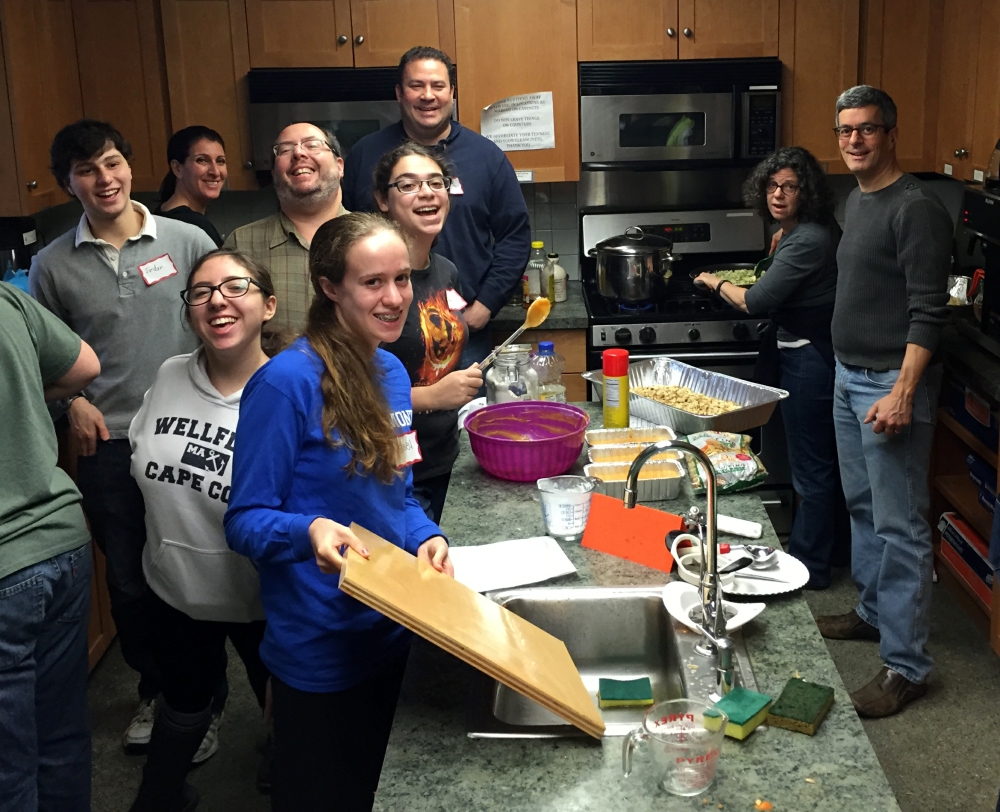
My 10th grade families prep Thanksgiving dinner for the homeless

The second Thanksgiving experience is meeting my Confirmation families in the vestibule just outside those sanctuary doors and spending Thanksgiving morning preparing a turkey dinner with all the requisite fixings that we then deliver to the VOA Shelter in Valhalla. In my opinion, there’s no better way to prepare for my Thanksgiving meal than by joining together with my temple family in assisting other families so that they can also celebrate Thanksgiving.

By the time I sit down to the third prong of my Thanksgiving experience – the Dreskin turkey dinner with the people I love most – my heart is already full and just waiting for my stomach to catch up. I go to sleep more spiritually satisfied on Thanksgiving than perhaps any other day of the year.

I share this with you because we’re living in an especially unsettling and disturbing time in history. And we should be disturbed. No one should celebrate this weekend without acknowledging the continuing injustices of American racism, American sexism, American homophobia, American economic inequality, and American diplomatic arrogance. Not to mention, the continuing American indifference to the Native American. Did you know that there has never been a public apology for our government’s murdering American Indians by the tens of thousands, stealing their land and booting the survivors onto reservations. This week marks the 150th anniversary of the Sand Creek Massacre, in which 200 women, children and older men were killed by Union troops during the Civil War for no militarily justifiable reason. What we did to the American Indian is unconscionable. That no one in this country has ever said “We’re sorry” defies both my comprehension and every fibre of my being that thinks about and tries to do what’s right.

jacobs-ladder

Jacob’s Ladder (Dennis C. De Mars)

In this week’s Torah parashah, Vayetzay, Jacob dreams his famous dream of a ladder that reached into heaven and which had angels moving up and down its rungs. Jacob’s understanding of the dream was that God was nearby, so Jacob offered to allow God to be his God if Jacob was able to safely return home from the journey upon which he had embarked. This wasn’t exactly Jacob’s most noble moment, although it was somewhat more impressive than his earlier demonstrations of selfishness and arrogance when he sold his starving brother a meal and stole that brother’s blessing from their dying dad.

Sometimes I’m so grateful that my ancestors were being persecuted and pummeled in Eastern Europe while the early American settlers were destroying this land’s indigenous peoples. But my being a descendant of Jacob the Deceiver doesn’t bode much better. The point here, I think, is that we humans bungle life a lot. We hurt and destroy, taking what we desire, with nary a pause to consider the dishonor of our actions.

The great irony of Thanksgiving is that it celebrates a moment in our American past that, even if such a meal really occurred, served as a prequel to a disaster of cruel and epic proportions. It’s just possible that Thanksgiving ought to be called Apologiesgiving, something akin to an American Yom Kippur.

But just as Jacob’s story doesn’t end with his shortcomings, but with a transformation that enables him to reconcile with, and finally offer love to, his brother Esau, and then to father Joseph who would shine as a leader not only of our people, but of the ancient Egyptian people as well … just as Jacob’s story turns to these finer values and better outcomes, so too can the American story, which in places already has.

Racism may not be gone, but America is a whole lot better place to be black than it used to be. Same with sexism and with homophobia too. There’s so much more work to be done, but we’ve made enough progress that we needn’t feel discouraged; we need merely to strengthen our resolve.

GivingThanks.02True thanks, of course, is not something that’s demonstrated by stuffing our gullets. There’s nothing at all wrong with a symbolic, ritual moment. Goodness knows, I’ve participated in more than a few of those myself. But what’s vital is that our symbolic acts become literal, hands-on endeavors to bring a fuller, more complete justice into our communities.

Ferguson, Missouri, is a moment teaching us that the work of the civil rights movement is not done, that beyond our legal system we still need to integrate values of tolerance and brotherhood into our daily lives. And I think we can do it. When I look at the transformation of this country vis-a-vis same-sex marriage, now legal in 35 states, I am so deeply hopeful. Things do get better. Life can and does improve, even if it sometimes takes a very long time. Always too much time. But we get there, don’t we?

And on this Thanksgiving weekend, that’s worth giving our heartfelt thanks.

Committed to Memory

Well, I took quite the stroll down memory lane this week. Ellen and I watched the film “Old Yeller” for the first time since I was maybe four years old. Fess Parker as the dad and Chuck Connors as the young cowboy who lets the little boys keep his runaway dog, these triggered additional memories of Davy Crockett and The Rifleman. But the story of the fearless, loveable pooch who saves his adopted family but must ultimately be put down because of “hydrophobia” – rabies – tugs at the heart strings like no other tale.

Something else was at play, something that pulled me along and prompted me to view the film again some fifty years later: nostalgia.

145938Nostalgia is a feeling that appeals to many, and offends some. I’m not quite sure when it kicked in for me, but it’s a condition I’ve got now. Katie, by the way, seems to have been born with it. I’ve never met someone so young who loves to look at “old” photos and videos even though they were taken only a few years earlier. Still, I won’t complain – who doesn’t want their kid to sit with them for hours and look at family scrapbooks?

I got to wondering though. Is nostalgia simply a personal indulgence, a moment of instant gratification that serves no real purpose other than to create a feeling of euphoria for times gone by? Or is there some practical reason for its existence? Is it built into our DNA for survival purposes, something akin to our flight-or-fight response?

Dr. Alan Hirsch – neurologist, psychiatrist and director of Smell and Taste Treatment and Research Foundation – in his article, “Nostalgia: A Neuropsychiatric Understanding,” explains nostalgia as “a longing for a sanitized impression of the past, what in psychoanalysis is referred to as a screen memory — not a true re-creation of the past, but rather a combination of many different memories, all integrated together, and in the process all negative emotions filtered out.”

Makes it sound kind of pathological, doesn’t it? Some fifteen years ago, I did a bit of talk therapy to work through some life-issues and mentioned to my therapist how precious my summer camp memories are to me. He dismissed them, convinced that I’d altered those memories so that they seem a whole lot better than they actually were. Except that I can remember the negative moments from my five summers as a counselor. And to this day, therapist be damned, I use those summer memories as a touchstone for the kind of experiences I gravitate toward in my life today.

Am I correct about this or was he? Dr. Clay Routledge, social psychologist and associate professor of Psychology at North Dakota State University, writes, “When you’re nostalgic about something, there’s a little bit of a sense of loss—[the moment has] happened, it’s gone—but usually the net result is happiness.” And so I imagine there’s a balance to be struck here between the appeal of looking back and the necessity to not dwell there for too long.

Which brings me to Sukkot. It’s so fascinating that, for one week each year, we dwell in our past. Literally. Jewish tradition has us move outside of our homes and live in rickety, primitive structures we know as sukkot. Funny enough, no one really knows where the sukkah comes from. Some teach that they were the booths in which our ancestors slept during the forty years of post-Exodus wandering. Others tell us that sukkot were the booths in which our farming ancestors who who had settled the nation of Ancient Israel would stay throughout the harvest period when there wasn’t time to return home each night lest the ripened crops spoil because they weren’t gathered in time.

Whether or not we actually dwell in a sukkah, the festival of Sukkot – like many of our holidays – involves a powerful look backwards. I doubt many of us yearn for a return to houses that welcome in the chill and the rain and which we often share with bees that are attracted to the produce we’ve attached to it. So why do we hearken back to a time we’re not even sure took place?

As always, there’s more than one answer – often many more – to a Jewish question. For me, Sukkot reminds me that my ancestors had once been slaves (whether they had been or not). Impoverished, harassed, oppressed and indiscriminately murdered, that is a world I neither want to ever again be part of nor will I stand idly by while the same happens to others. Thus, when 400,000 Muslims were murdered in Darfur, our synagogue took a stand. When a million Rwandans from the Tutsi tribe were murdered, our synagogue took a stand.

And our Jewish sensitivity to slavery doesn’t extend only to brutal killings. Other “slavery” in our world – systems in which people are set apart and their basic rights are trampled – include mistreatment of women, of people of color, of those with a different sexual orientation. Also, we take a stand to protect the rights of our brothers and sisters living in Israel, even as we try to figure out how to advocate for innocent Palestinians in Gaza while not turning our back on Israel.

All of this because of Sukkot, and a history that has shaped us as a people that won’t stand by while others suffer. We are a people who regularly dwell in our past. Even though there’s not a whole lot back there to miss, we nevertheless climb into Mr. Peabody’s Wayback Machine and take those journeys so that we never abandon our stories, nor the valuable lessons we learn from them.

Antisemitism, it seems, is on the rise. The ADL estimates that 26% of the world’s population harbors antisemitic attitudes. Well, what’s new? Or rather, what’s old?

Antisemitism is old news. There’s ever a certain nostalgia to it. It gets our blood running, makes us feel indignant and, more importantly, proud. Nothing raises a person’s sense of Jewish identity more than the knowledge that it’s under attack. Wanna raise money. Forget Jewish education or building up Jewish spiritual practice. Respond to hate. That’ll get the dough rolling in, for sure.

Yes, there’s a lot of antisemitism in the world today. But things are different this time, different from the 1930s and 40s to which folks seem to be comparing today’s events. The differences, in western countries anyway, is that the governing bodies are neither tolerating nor legislating antisemitism.

Last month, when a man in Britain spewed antisemitic language on a bus filled with Jewish schoolchildren, he was arrested, charged and found guilty of using threatening language to cause alarm and distress. In the Netherlands this past July, two men were arrested for shouting “Death to the Jews” and inciting racial violence during a protest at the Hague. And in August, French police arrested two young women who were plotting to attack a synagogue in Lyon with explosives.

I’m not saying that these acts are in any way defensible. They are as reprehensible and condemnable as any act of bias can be. But there’s a huge difference. The countries in which these hate-crimes are taking place have governments that are responding, that are not tolerating this behavior. I could be wrong. I often am. But I don’t think we’re headed toward a second Holocaust. It’s a mess, to be sure. But it’s a very different mess from that of seventy years ago. And while it’s important to look back, it’s also important to differentiate then from now.

Author Michael Crichton writes, “If you don’t know history […] you are a leaf that doesn’t know it is part of a tree.” There are so many lessons to learn from the past. And even if it’s just to smile and sigh a bit at days of wonder gone by, the past connects us to one another and to the stories that impel us into our future. It also teaches us what a hot stove is, figuratively and literally, and to stay away from it.

But sometimes we can’t.

Country singer Glen Campbell released a powerful and unsettling video this week, entitled, “I’m Not Gonna Miss You.” Diagnosed with Alzheimer’s in 2011, and resigned to the disappearance of his ability to remember anything, he wrote and recorded this song with the understanding that it will likely be the last one he ever makes:

I’m still here but yet I’m gone
I don’t play guitar or sing my songs
They never defined who I am
The man that loved you ’til the end

You’re the last person I will love
You’re the last face I will recall
And best of all
I’m not gonna miss you
Not gonna miss you

I’m never gonna hold you like I did
Or say I love you to the kids
You’re never gonna see it in my eyes
It’s not gonna hurt me when you cry

I’m never gonna know what you go through
All the things I say or do
All the hurt and all the pain
One thing selfishly remains
I’m not gonna miss you

For Glen Campbell, and everyone else who suffers from diseases that rob them of their memories, nostalgia becomes something in which only we can indulge, reluctantly embracing those bittersweet memories of better times spent with those we love, those for whom stories – the past – no longer exists.

During Sukkot, we pick up the lulav and the etrog, waving it in all directions to affirm that goodness exists everywhere. We even shake it behind, although we designate that only as one of the coordinates on a compass. Regardless of where we point those ritual objects, our tradition does embrace the past and acknowledges the goodness that is to be found there. Our stepping inside the sukkah is a step into eras gone by, ones that we happily visit alongside friends and family, always with the hope and the faith that we will together build a brighter, better future for all.

The time will come when our memories are no longer ours. Whether from disease or from death, our journeys will come to an end. Let us hope, that as we remember the significance of our ancestors’ stories, future generations will want to celebrate the benefits and goodnesses that were created by ours. Whether future generations sanitize their recollections of how we lived, or they remember us with all our scars and all our warts, may those memories – like our lulav and etrog – ferry sweet wisdom from our time to theirs, as a perpetual gift of goodness, of promise, and of love.

Billy

Lighting Up the World

LighthouseIn this past weekend’s New York Times Sunday Review, an article appeared on the subject of lighthouses. James Taylor used to sing about lighthouses: “I’m a lonely lighthouse, not a ship out in the night, watching the sea. She’s come halfway ’round the world to see the light and to stay away from me.”

But like rotary telephones, typewriters, and S&H Green Stamps, lighthouses are mostly no longer needed. I hadn’t actually realized that technology had overtaken them too. Apparently, GPS works so well on land and sea that boats no longer require visual cues to keep them away from dangers that lurk in the watery depths.

So, like trying to figure out what to do with the first Tappan Zee Bridge once the second gets built, communities must determine whether or not it’s economically feasible to keep decommissioned lighthouses standing. It can take millions of dollars to keep a lighthouse in working order. So unless there’s a way to monetize that, it’s unlikely such maintenance will survive budget-time scrutiny.

Some lighthouses have been turned into out-of-the-way bed and breakfast inns. Others have simply been preserved as museums. The rest are being torn down.

I’ll come back to lighthouses in a moment.

MtSinaiA couple of thousand years ago, our ancestors stood together at a mountain called Sinai and received a document, along with a charge for how to live, that would direct their lives for the next hundred generations. In this evening’s Torah reading, Nitzavim, we will hear about that moment, and about who it included, which may surprise a few of you. In the book of Deuteronomy, chapter 29, we are told that every Israelite stood at the foot of Mount Sinai when Moses carried down God’s Torah. What’s wonderful about this passage is that the moment was not one of privilege or status. While yes, Israel’s leaders are there – they kind of have to be if this people is going to have any chance of following the new book of rules – so is every other Israelite. Spouses, kids, out-of-town guests, and even those at the lowest rungs of antiquity’s social ladder: woodchoppers and water-drawers.

The light from a lighthouse acknowledges no social standing, no financial position, no political connection, no prejudicial bias. That light is for everyone, to help one and all steer clear of danger.

Nitzavim, this week’s Torah reading, is a lighthouse. It offers its gifts to anyone who wishes to partake. I think it’s the perfect text to begin our new year.

Woodlands Community Temple is a pretty special place. I don’t know that it’s dramatically different from many other special places – other synagogues, churches, mosques, bowling alleys, American Legion halls, community centers, or any other room that houses a group of people who are trying to do something to elevate the value and meaning of their lives (a tall order, to be sure, but not at all unachieveable) – but the social experiment of building community to make life better for one’s self, one’s family and one’s world, is not only noble, it’s needed. It’s not a particularly difficult task to care for one another, but we do manage to trip over our own feet quite a bit of the time.

Nevertheless, good things have come out of the lighthouses we call synagogues. We teach our children values by which we hope they will live. We remind ourselves of those same values and encourage one another to strengthen our resolve to live by them. And we shine our light on people and places outside of our synagogue – not to convert, but to embrace. Through social action – tikkun olam, g’milut hasadim – we lend a helping hand to others because this ancient document has been challenging us to do so.

This may be why we read this particular passage from Nitzavim a number of times each year. Our Confirmands will read these verses next spring during their Shavuot service of Confirmation. Why? Because we hope they will internalize the Torah’s message of common vision and action. We will read it on Yom Kippur morning, just two weeks from now. Why? Because its “lighthouse” concept of helping one another to ennoble our lives is the challenge of the High Holy Days. To be written for a blessing in the Book of Life is not something we seek only for ourselves, but for every inhabitant of this planet. That is the Jewish dream, one we renew each year in that tent.

Two brief stories.

One comes from an animated short entitled “Lighthouse.” It concerns a lighthouse whose light unexpectedly goes out. With a ship fast approaching, the keeper of the lighthouse, not knowing what else to do, runs downstairs with the goal of heading into town and appealing for help from his fellow villagers. But when he opens his front door, he finds them already arrived and, lanterns in hand, the entire village ascends the steps of the lighthouse to warn off the approaching ship.

A sweet, powerful little story that reminds us of the importance of being part of a community and of stepping forward when the need is great.

Woodlands Community TempleThe other story concerns the building of a synagogue. A long time ago, plans were drawn up for the design of the community’s new synagogue. At its dedication, everyone came and marveled at the building’s breathtaking beauty. It wasn’t long, however, before someone notice the building had no light. “Where are the lamps?” someone asked. “How will our new synagogue be lit?” The rabbi indicated a number of brackets that had been mounted on the walls at regular intervals throughout the building. He then presented each family with a lamp that they were to carry with them whenever they came to the synagogue. “When you are not here,” the rabbi said, “part of this synagogue will not be lit. When you remain at home, especially when our community needs you, some part of God’s house will be dark.”

I love this story! And while I doubt that our Board of Trustees would go for implementing it as policy, the metaphor has indeed been implemented. As with any community gathering, Woodlands is strengthened by the participation of many, by your participation. When we come, you and I are strengthened. When we come, our families are strengthened. When we step forward to join our community – in whatever activity it inaugurates – our lives are affected. And like those old lighthouses, when we do step forward and we shine our light, our wider community, maybe even the whole world, is affected as well.

Billy

When Does Night Become Day?

in honor of Israel’s 66th birthday

Flag.05It was back in 2006 that Jay Leno observed what he called “positive news” from out of Israel. “Both sides are signing off on [President Bush’s] road map to peace,” Leno said. “The bad news is the Israelis think the road goes through the West Bank, Palestinians think it goes right through downtown Jerusalem.”

More recently, theoretical physicist Stephen Hawking announced his support of the boycott against Israeli products. Hawking was apparently unaware that his speech computer was designed in Israel when he made the following statement to reporters, “I’m an antisemitic pig who loves rolling my wheelchair across my cat’s tail.”

What is it they say, “If I didn’t laugh, I’d be crying”? The news out of Israel these days isn’t so good. Not that it ever is. But I’m usually filled with much more hope. Silly me, I really thought that President Obama’s peace initiative via John Kerry would move genuine peace talks forward. But now, the only question people are asking seems to be whether the talks are dead or just dying.

And then, earlier just this week, we learned that the Conference of Presidents of Major Jewish Organizations rejected J Street’s bid for membership. 50 organizations are represented in this coalition, and only 17 of them thought that adding J Street to their roster would be a good idea. So, in essence, they shut down the only really alternative voice the American Jewish community would have had in the conversation about Israel.

Here at Woodlands, we’ve met the leadership of J Street. These are not hysterical, unhinged people. They’re thoughtful, caring people who happen to think there are other ideas for how Israel might manufacture its future. This week’s vote is just another in a long string of refusals to engage with J Street’s points of view.

It’s just so sad because, while I happen to subscribe to much of what J Street thinks is the path ahead, I’m more saddened that the conversation can’t even take place. For quite a while now, American Jews have offered little to no room for debate on Israel. Remember the bumper sticker, “America: Love It or Leave It”? That’s what it seems is the only voice allowed when it comes to Israel.

Those who dissent from the party line are branded as traitors to Israel’s cause. Those who suggest that we might find a way to live alongside the Palestinians are labeled as accessories to murder. Those who read Ari Shavit’s The Promised Land and encounter, perhaps for the first time, his telling of a version of the 1948 War of Independence where Jews also play a role in pushing Palestinians off their lands, find themselves spurned for bastardizing history.

If America, great as this country is, has never been a perfect democracy, with perfect leadership, or an unblemished record of behavior, why would anyone presume that Israel would achieve that. We wanted it to, I get that. But after a while, I’d assumed we would all wake up from that little daydream. Israel, like America, like every other country, has its dirty laundry. It remains a great country. A bastion of democratic values, of compassionate governance both inside and outside its borders, and a petri dish for innovative industries and technologies. As I am proud of the United States, even with all its warts, I am also proud of Israel, which falls short much of the time as well.

There are great achievements there. We write about them every month in Makom, in the column we call, “Just Israel.” So many justice-oriented activities are going on there, many sponsored by the government, many taking place in spite of the government: Israeli and Palestinians scientists researching HIV together, a multi-denominational social action training program that empowers disparate groups to solve serious social problems together, greater recognition of the homosexual-lesbian family as full members of Israel’s social fabric, the Israeli Supreme Court ordering the end of illegal, coercive, and involuntary segregation on public buses, also ordering the Security Fence to be moved when it violates Palestinian rights, an Arab and an Israeli entering the Eurovision song competition together, the most terror-free period in Israeli history, 120 new Palestinian schools, 3 new Palestinian hospitals, 50 new Palestinian health clinics, a 1000 new miles of Palestinian roads and 850 new miles of Palestinian water pipes.

Things are changing there, to be sure. Not quickly enough. Not enough insistence, from both sides, that neighbors stop seeing each other as enemies and become much more resolute in building their neighborhood, their peaceful neighborhood, together.

I want to show you a video. It’s not about the Middle East. But it could be. It illustrates how you and I can go about our daily lives and miss seeing our family. The people in this film really are family. Shouldn’t Israelis and Palestinians see each other this way too?

http://www.youtube.com/watch?v=u6jSKLtmYdM

The issues confronting Israel are not unique to that land. God knows, we have a long way to go before we can see (or perhaps stop seeing) people whose skin color isn’t white, whose sexual orientation isn’t straight, whose gender isn’t male, whose earning power isn’t affluent, and yes, who live in houses or apartments and not on the street. But Israel is a magnet for powerful emotion and opinion. And for you and me, it’s a place we wish would do as well, if not better, than our own country in resolving its social deficiencies.

The first step is learning how to talk to each other. John Kerry should never have to come home. The Israelis and Palestinians should build him a house right on the Green Line, and a day shouldn’t ever go by when they’re not meeting with him to work toward peace.

And you and I should learn how to speak to one another about Israel too. Just as J Street should have a seat at the table, we need to learn how to talk about these issues with each other without getting angry, without judging, without labeling one another as the enemy.

A good start has arrived to Woodlands. Part one of an exciting program that comes out of the Shalom Hartman Institute in Jerusalem, “Engaging Israel,” has allowed a goodly number of us to talk about the values we believe should govern a Jewish state without getting lost in our highly-charged opinions about individual Israeli policies. Part two of “Engaging Israel” will begin next November. It’s the best conversation on Israel and her neighbors I’ve ever experienced. I hope you’ll join us.

The second step is to build real bridges, real partnerships, real peace. You and I probably can’t do that here, although we can bring Palestinian and Jewish singers to our bimah as a symbolic expression of our hope that such friendships can continue to be grown there as well.

It’s Israel’s 66th birthday. It’s still a miracle that a Jewish nation exists. And it always should. But it’s time for a new miracle. Jewish tradition asks, “How can one tell when night has ended and the new day has begun? Its answer: When you can look into the face of a stranger and see that he’s your friend.” May the Jewish people, wherever we reside, never cease reaching out and extending a hand of hope, of goodwill, and of peace.

Happy birthday, Israel. And many, many more.

Billy